This is Part One of a two-part email exchange between Myq Kaplan and myself. (Thanks to Gladwell-Simmons for the inspiration.)
Ruby
I'll start with this: You've mentioned Stanhope is your favorite comic out there. This seems curious to me since you have such a different style than him. Why do you love him so much? Do you see your comedy evolving in a more Stanhope-ian (or other) direction in the future? Do you think consciously about big picture "what is my voice?" stuff like that or just take it one joke at a time?
Kaplan
Stanhope is indeed one of my favorites to watch and listen to. To start with, I have a difficult time saying he is number one above all others, because there are so many amazing folks out there that make it difficult to compare. Though that's the great thing about comedy, is that everyone who is great at it is great in their own way, from Stanhope to Paul F. Tompkins to Reggie Watts to Ellen DeGeneres to Steven Wright to Brian Regan to Louis CK to Sarah Silverman to Andy Kindler to Dave Chappelle to everyone else, etc. And it doesn't have to be a competition. Unless it's televised and there's prize money.
It is true that many of the comics I love do something different than I do, stylistically. But certainly, what I love about Stanhope is his content. As a human being, I care about a lot of the things that he talks about, topics like overpopulation and discrimination and the various ills facing the inhabitants of this planet (and maybe the universe if we someday screw up even bigger than ever). Additionally, the angles that he takes on these issues are usually different than 99% of the typical perspectives you hear argued out there. E.g. his take on whether there should or should not be gay marriage: there should be NO marriage, period. Things like that. A lot of people throw the word "genius" around where it might not belong, and who am I to not be like a lot of people? Great numbers of people think a like, right? Point is, he's a genius at what he does (and I'm a genius at genius-spotting). He's also super-prolific, which I love, and very hard on himself, which I don't think is necessary, but certainly serves to serve his being prolific, thus avoiding being complacent and constantly moving forward creatively. Or at least moving sideways, but at such a level that who cares which way he's moving, it's just wonderful to take in.
I don't think it would make sense to only enjoy people that are similar to yourself. If I only listened to Mitch Hedberg and Emo Philips and Demetri Martin and Brian Kiley and Steven Wright and other wonderful jokesmiths, I'd have a lovely time but would certainly be missing out on the wealth and range of comedy options out there. If you're only enjoying folks similar to yourself, then who would watch Reggie Watts?
That said, with respect to the question of my comedy vs. Stanhope's, I do also currently aim to address the woes of the world in my way. I don't do it exclusively, but I discuss social issues that I care about like homophobia, racism, sexism, animal cruelty, etc., amongst the logic play, the word tricks, the silliness, the jokes about comic books, movies, and whatever else I'm talking about at the moment.
I certainly imagine my comedy will continue to evolve, though I don't feel as though I need to be the architect of that evolution. Seinfeld said in "Comedian," I believe, something like (paraphrasing) "if you ask any comedian where he gets his joke ideas, and he can tell you, he's lying," that we all have our muses, our selves, our voices, our personas, that develop without necessary any conscious guidance. And that really makes sense to me. After all, would you ever say, "Steven Wright, I've enjoyed everything you've ever done, but could you tell us what's REALLY inside of you? What REALLY happened when you spilled spot remover on that dog?" I mean, he seems like a very interesting dude, but if he never evolves towards being a more confessional comic, I don't think it would be reasonable to slight him for it. He is a brilliant artist with the palette he has chosen, or that has chosen him, even.
And what about some of the great comics who HAVE undergone a drastic shift of style over the years? Paul F. Tompkins is one of my favorite, and I thoroughly enjoy both "Impersonal" AND the more personal stuff he's doing today. Same with Louis CK's absurdity of the past and his laser-like truth-gun of hilarity today. (For the record, I have a friend who prefers CK's absurdist past to his honest, everyman present, on the grounds that his previous absurdism was just as honest, because that was who he was, truly.)
This might be getting a bit far afield of your original question, so to get back to it—I imagine there are ways in which I'll never be like Stanhope, and there are ways in which I'll always be myself. Though the self is an ever-changing, ever-evolving being, and as my comedy today is certainly different than it was five years ago, I presume/hope/imagine that it will be somewhat different five/ten/fifteen years from now as well.
As to whether I have big picture goals and aspirations about my voice and the comedian I'll be, I think it makes sense to say that on a theoretical level, yes, but on a practical level, one joke/idea/riff/story/thought at a time is how it works. I read a quote about how analyzing oneself is like trying to bite one's own teeth, so while it can be a good philosophical exercise, ultimately the only thing you can do is do, or be (so, two things).
The only real conscious decision-making portion of it all might be figuring out which jokes go into a TV set, a special, a CD, a headlining set, etc. This is something that everyone faces eventually. When you start out and you only have 5 minutes of material, there is no question of which 5 minutes you share; you share everything. But eventually, choices need to be made. And on what grounds? Do the funniest stuff only? Or do stuff that goes together thematically? Stuff that says something about a particular topic that means something to you? Stuff that is more personal? Stuff that is just fun for you to do? Or stuff that audiences consistently love the most?
Ideally, it would be wonderful if all of those things were the same. But even for the best, it might not be that way. Louis CK has talked about throwing out chunks that kill because they don't fit in with everything else he wants to do. That's impressive and amazing to hear. Right now, I'm just working and writing and heading towards the next hour to record, at which point I may have to decide on how to whittle down more than an hour's worth of material that I'm happy with. Maybe I'll pick the stuff that's most meaningful even if it didn't get the most laughs (is that Stanhope-ian?), or maybe I'll pick the stuff that tickles me the most, even if it's not the most socially relevant (is that Stanhope-ian?). Or maybe some producer or editor will pick, even though they told me I would be involved in the process (that is definitely less Stanhope-ian, and I hope to evolve away from that as much as possible, for sure).
Ruby
It's interesting. So many comics seem to be searching for their "voice" and yet the act of looking for it is seemingly a waste of time if it's something you can't really consciously decide upon. Like you say, the only thing you can do is be.
(Before I go further, let me acknowledge that while you're doing spots on the Tonight Show, etc., I'm still scraping by for gigs and doing mics. I don't want people to think I'm considering us on equal footing. Ok, caveat = taken care of.)
Lately I've been feeling that finding your voice is really more about eliminating things than finding them. Like you need to say: Yes, this is something I could talk about onstage and probably get a laugh from. But that is pulling me away from who I want to be and how I want the audience to see me. In that way, what you say no to feels like the key.
For a long time, I felt a sense of desperation to get laughs however possible. Only recently have I considered that maybe laughs aren't the most important thing...well, that's not right....more that there is a quality to laughs. You can get big laughs with a dick joke or mocking Sarah Palin but it is not equal to getting medium laughs with something that is actually personally revealing. The idea of taking emotional risks onstage, as I've heard Marc Maron describe it. That even if something doesn't get a huge laugh but it does show you out there being vulnerable and revealing yourself, it is worth more than something silly that does get an audience going. It's something they might actually think about a few days later after they've forgotten other stuff. And it's a way for them to remember you as a person instead of just a mask spouting off a collection of jokes.
Also, I've got a new bit I'm working on where I worked in a reverse way than I usually do. Usually I'm out there hunting for funny things and then testing it on an audience for confirmation laughs. But this new thing (about a family conversation I had) started with me going onstage and just telling a story. I felt engaged with the audience in a different way than usual. It wasn't funny that first time I did it, but I knew that it was something to stick with. (And people came up to me and told me so afterwards, which is rare for a bit that isn't really working yet.) So I've been doing it for the past few weeks and trying to force it into something funny. It's getting there but still needs some polishing, especially at the ending. But it's been interesting to start with a topic and then figure out what's funny about it instead of starting with something funny and then figuring out how to expand it.
Btw, back to the voice thing. Do you think you've found your voice? When I think about your comedy in this way, I wonder how much of "Myq Kaplan's voice" is the rhythm and style which you speak about things as opposed to the content of what you're saying. Do you ever think about this? That maybe you can talk about anything now because you've got a distinct delivery/tone and it will still sound like you. I feel like pace is more important to you than it is to a lot of comics. Like if you talked slowly (like, say, Todd Barry), you'd be an entirely different comic.
Also, I never saw you in your early years doing standup. When do you think you started getting good? Were there pivotal stages in your development that you look back on as "awakenings"? (By that, I mean were you in a coma and did Robin Williams help you get out of it.)
And while I'm piling on the questions: Do you think there are different "requirements" for a newer comic than an established one? Is it silly for a comic who is, say, four years in to try to do what Stanhope or CK is doing right now? Do you think you have to establish your short game (presumably with tighter, quicker jokes) before you can shoot for the moon with long game bits that really dive deep like Stanhope's "fuck the Jews" or CK's "everything's amazing, nobody's happy"?
Kaplan
One problem with a newer comic trying to do what someone great is doing is just that—trying isn't doing. I don't mean to get all Buddhist or Yoda up in here, but what I mean is, a lot of people starting out will see Pryor and then just swear a lot, or see Stanhope and then just talk about horrible things that they've done. And when they're not also bringing the poise, talent, and years of experience that those geniuses bring, it will very often just come off as crazy yelling or aggression with no point. And while some new folks may see Steven Wright and then just start out being weird by emulating him (which will require shedding from one's act to eventually find oneself, just as the Stanhope wannabe must), at least the Steven Wright wannabe won't immediately turn off or shut down the audience in a way that the misguided swears and horrible truths can (when not accompanied by craft/skill/humor).
And of course I'm not advocating censorship. Anyone starting out can say whatever they want. But saying certain things might lead towards the path of finding oneself more quickly than others, at least initially. And this isn't just about the practical notion that if you're always walking the room, you might have trouble getting bookings (which provide the stagetime necessary to gain the experience to stop doing the bad thing). There's a Patton Oswalt interview where he compares getting great at comedy to becoming a great chef, wherein the chefs start off just cooking rice until they can make the best rice, and that some aspiring comics want to skip the part where they learn how to cook rice.
I'm sure there are exceptions. I don't know what Chappelle was like when he started as a teenager, but he's a guy who seems like he might have been ready to go very early on. It's hard to imagine a Chappelle who doesn't just exude funny. But if you're a new comic, think about the odds that you might not be a one-in-a-million genius, at least not at the get-go, and do the work.
And one might ask who am I to make this assessment? Good question, because I am someone who started out writing one-liners because they're what came most naturally to me. What if they don't come most naturally to you? Well, look at amazing story-tellers like Mike Birbiglia, or raw truth-tellers like Marc Maron... And then look at them do a late-night set where they are also extremely capable short-form joke-tellers. They know rice, as well as great poignant stories about rice.
As far as my start in standup, and when I started "getting good"... This should all be taken with as many grains of salt as necessary, because I know there are folks 25 years in that think they just started getting good 23 years in. It's an ongoing process, and when Seinfeld and Chris Rock are 50 years in, they'll still be having insights about how good you get in your comedy 40s.
But comparing where I am now to 8-9 years ago... I think my writing was closer to where it is now than my performance was. I look back at tapes from my first few years and I'm horrified by the stiltedness of my delivery, the unnaturalness. And this isn't to say anything about how I feel about my performance now. I honestly don't think about it consciously that much all the time (other than the occasional consideration about speed), but the general advice to "just keep doing it and you'll get better" has been paying off, I think. And hopefully it will continue to do so.
As far as my writing goes, there are things that I wrote that were good years ago that I didn't even know were good until more recently, or that I couldn't MAKE good until more recently. And there were hundreds of things that weren't good. And today I'm still coming up with hundreds of things that will never see the light of day more than one or two times, until maybe 10 years from now when I look back and figure out how to make THESE things good. What I do think I've gotten better at is knowing how to prioritize, figuring out what jokes have the most potential more quickly, or what jokes I'm more interested in making have more potential. I also do a lot more writing/riffing on stage now than I ever did when I was starting out, and I'm not really sure when that started.
It was all a gradual process, with little milestones along the way. Getting to different rounds of different contests and festivals, having college friends that didn't think I was that funny when I started change their minds, having other comedians I respect respond positively to what I was doing more and more, just getting to work for certain bookers and venues in the Boston area, ... when the booker of the Comedy Connection saw me do well at the Boston Comedy Festival one year, and then a few months later booked me for my first weekend opening for a national headliner there, that was a moment where I saw the results of the gradual changes that had been slowly coming into being. That was probably around 2005 or 2006, 3 or 4 years in? Everything was happening gradually up until that point, and then after it, but that was when I noticed more people noticing and caring what I was doing, when previously it seemed like no one was noticing (but in fact people might have been noticing and not caring).
As I type that last part, I realize that might not have been what you were asking, because that was about external stuff rather than the internal stuff you might have been after... so here's the answer to that, I think... you never really know if what you're doing is any good. Or maybe not never. But let's start with never. You take a joke to an audience. You think it's a good idea. They don't. When you're starting out, you might give up. Now, if I still think it's a good idea, or if one out of ten audiences tells me it is, maybe I know better how to use what that one good audience told me, in order to make it nine out of ten audiences liking it. At some point along the way, I learned a certain kind of confidence that seemed more justified than the delusional confidence that a lot of us start with (which is often necessary). I don't know when that happened, if there was a lightbulb or if it was also gradual. But eventually I reached a place where I knew that I could make things work, creatively. Not for every crowd, but for myself (most importantly), and for my crowds, and for most crowds, even.
This is getting long (that's what Pinnocchio said! which would be a lie if he said it, and then it wouldn't... Pinnocchio really could have done some paradox testing), so I'll try to wrap it up, with the topic of my voice. Have I found it? Does it pertain to my pacing? What is a voice?
I do consider how fast I speak sometimes. I've gotten notes about it before, from varying sources and types who give notes. A goal of mine is obviously to be understandable, and also to be myself. My self does speak more quickly than a lot of people, so on stage it's not that different all the time. Though there are times when I consciously make an effort to slow down, at which point I don't believe my persona or self or voice gets lost or distorted in any way. One of the best shows I ever had, the audience was laughing so much that I had no choice but to slow down, wait for them, and move forward. And that's the thing—like with tennis where some people play up to the level of any opponent, I find that often my pace will match the audience. If a joke makes them laugh this much, the next line comes that much sooner. Some of the jokes are built to roll, keep moving forward, and so it becomes a conversation (like has been said of standup before), as opposed to me just saying what I want to say at the rate I want to say it.
It's possible that I just speak quickly because I have a lot that I want to say. Life is short, and I want to cram in as much living and talking and idea-sharing and joke-telling as possible. I think that that mindset definitely informs the style that I've grown into. Maybe it will change at some point. Maybe I'll change it.
So, I wouldn't say that I've found my voice, because I was never explicitly looking for it. Maybe someone would say (in their voice) that my current voice found me. Maybe someone else would say that that's splitting semantic hairs. Maybe a further person would say that splitting semantic hairs IS my voice, or at least one thing that my voice is good at saying. Maybe all of these people are me.
I'll leave off going back into whether I think getting to know someone with fewer laughs is more or less valuable than laughing tons at silliness. I will say that some of my biggest laughs have come from Brian Regan's silliness and Louis CK's absurdities, in addition to Stanhope's truths (which, in truth, sometimes make my brain marvel more than laugh uproariously, though they do both... but that might be why I love him, because of how he makes my brain feel, and I love feeling with my brain).
Questions for you: when you started comedy, were you confident? Should you have been? Did you think you were funny? Did you know that you weren't? Were you? Do you like confident performers? Is that a weird/vague question?
Go to Part Two.

6/27/11
The importance of smiling
Good interview with Neal Brennan. He talks about smiling and laughing onstage and how that makes you more likable.
Here's Brennan's Lopez set:
Interviewer Scott King also did a bunch of other good pieces with Attell, Burr, and Norton for their JFL Chicago shows.
Related: Malcolm Gladwell on what makes a great performer: 10,000 hours
I focus on performance. And being more dynamic as a performer. I used to do a thing, and I did it on my Lopez set, where when I was going onstage, I would give a friend of mine 200 bucks and for every time I smile onstage, you have to give me 20 bucks back. So I knew that if I wanted to get my money back, I would have to smile onstage.
It's like one of these things that's such a good practice. Because the first time I did it, I lost 120 bucks. But when I did it on Lopez, Lopez is easier, I did it and smiling helps. And I got my money back. So I do that, and I've been doing something recently where I watch the audience laughing, which I never did before. Laughing at my jokes, which makes you then laugh, and when you laugh you're more likable, and you're having more of a conversation with them. You're in the moment with them. Instead of just, "I am performing, we're having 2 totally different experiences now. You're having fun, but I'm working." No, it's like, "We're both having fun." So that's one thing.
And when I was in New York, I was working a lot with Aziz Ansari, and he has a really, really great work ethic when it comes to stand up. He listens to every single set he does. He'll write notes in his notebook about it, he'll change punch lines, he'll alter tags, and he's really really dogged, to the point of it being kind of weird to people. Because he'll be sitting at a table with a bunch of comedians, with his headphones on, just listening to his own stand up, but it really improves your (set). I remember when I was kid, I remember my brother Kevin and (Dave) Attell would tape their sets, and then when I was doing it I wasn't, and now I started, and I just know it makes you better. So I've been listening to all my sets. It's just also more positive reinforcement when you're listening to yourself get laughs right before you go on. So that's helpful also.
The other thing is you just need the flight hours. You just need the 10,000 hours, you need the reps. You have to do it, and do it, and do it, and do it. That's the thing with TV, you don't know how your body's going to react, you know. When I did Fallon, I wasn't as engaging as I was on Lopez because I didn't know what my body was going to do. My body tended to get a little small. Whereas on Lopez, I knew, "Hey, just so you know, Neal, you're body may get a little tight and small. So you have to counteract that." Which is why I did the smiling, 200 bucks thing.
Here's Brennan's Lopez set:
Interviewer Scott King also did a bunch of other good pieces with Attell, Burr, and Norton for their JFL Chicago shows.
Related: Malcolm Gladwell on what makes a great performer: 10,000 hours
6/24/11
Hot Soup with Dixon, Miller, and Hamilton
I'm in Boston doing shows tonight (6/24) but there's a stellar Hot Soup lineup...
FRI 6/24 HOT SOUP LINEUP
Pat Dixon
TJ Miller
Ryan Hamilton
Dan Soder
Justy Dodge
Jeff Wesselschmidt
Hot Soup!
Every Friday at 8pm
FREE SHOW
O'Hanlon's (back room)
349 E 14th St between 1st and 2nd Ave. (map)
Produced by Matt Ruby, Mark Normand, Andy Haynes, and David Cope
FRI 6/24 HOT SOUP LINEUP
Pat Dixon
TJ Miller
Ryan Hamilton
Dan Soder
Justy Dodge
Jeff Wesselschmidt
Hot Soup!
Every Friday at 8pm
FREE SHOW
O'Hanlon's (back room)
349 E 14th St between 1st and 2nd Ave. (map)
Produced by Matt Ruby, Mark Normand, Andy Haynes, and David Cope
6/21/11
Show photos: Kabin, Broadway Comedy Club, etc.
Photos I've recently taken at comedy shows/mics in NYC:
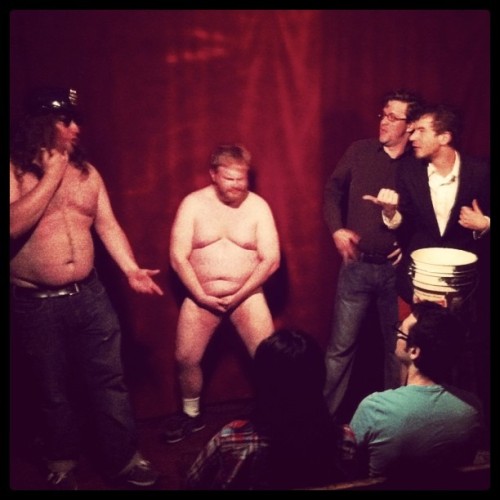
 FYI: I'm using Instagram to edit/upload these shots and I've been collecting them online at SandpaperSuit.tumblr.com if you want to follow along.
Stone Mill Theater (Little Falls, NY)
Village Lantern
Kabin 4-Year Anniversary
Treehouse
Freddy’s Back Room
Broadway Comedy Club
Hog Pit
6/20/11
Tracy Morgan's comments and what civilians will never totally understand about doing standup comedy
The Tracy Morgan conversation has folks arguing about just how much the comedy stage should be a "safe space." When I hear civilians lashing out at words said onstage, I think there's something they miss. Until you've actually performed standup comedy and talked extemporaneously to a crowd, you'll never know what it's really like. Once you do, you can't help but empathize at least a little bit with someone who takes that chance and fucks up.
Improvising or writing onstage is a tightrope walk. And if you're talking about edgy/provocative topics, it can be even more dangerous. That's part of what makes it so thrilling to watch. Make it to the other side and it can be magical. Fall off and you wind up in a shark pit. (Is that a thing?)
Comics defend other comics for the same reason that cops defend other cops; We've been there before. When a civilian hears about an innocent suspect that gets gunned down, he's outraged: "How could this happen?" When a cop hears about it, he'll say something about the stress of being in the line of fire: "You'll never know what it's like to approach a suspect and not be sure if he's reaching for a wallet or a gun." Luckily for us, we don't actually kill when we "kill."
Personally, I take anything that is improvised on a comedy stage with a huge grain of salt. Because I've said plenty of in-the-moment things onstage I later regretted. As bad as Morgan or Michael Richards? Probably not. But there has definitely been plenty of stuff I'd have to apologize for if everything I said was reported by the media. Take chances onstage and you're bound to misstep occasionally. And once in a while, you may misstep badly. That's part of the deal.
(Note: I'd be more likely to condemn a written/planned joke than a riff. Malice aforethought, etc. But I'd still probably be way more lenient on that than an ordinary person. Also worth keeping in mind: I don't understand being offended.)
The conversation reminds me of Dave Chappelle's thoughts on Richards' meltdown at The Laugh Factory. While performing on the same stage, Chappelle explained how watching the whole thing made him realize he's "20% black and 80% comedian."
Obviously Chappelle hates what Richards said. But he's been in the trenches too and can't help but identify with a guy who's losing it onstage while dealing with a non-receptive crowd. That's the empathy you get from walking in a comedian's shoes.
I'm not saying Morgan should have said what he said. I get why gay folks are especially pissed. I know the goal of those criticizing him is a noble one. But the road to neutered standup is paved with good intentions.
I believe the standup stage is a sacred space; It's one of the few places left where people are allowed to experiment, confront, and dance with ideas that society generally tiptoes around or avoids completely. That won't always go well. But if you try to take away the shitty part of that, you're likely to sacrifice the wonderful part of it too.
Improvising or writing onstage is a tightrope walk. And if you're talking about edgy/provocative topics, it can be even more dangerous. That's part of what makes it so thrilling to watch. Make it to the other side and it can be magical. Fall off and you wind up in a shark pit. (Is that a thing?)
Comics defend other comics for the same reason that cops defend other cops; We've been there before. When a civilian hears about an innocent suspect that gets gunned down, he's outraged: "How could this happen?" When a cop hears about it, he'll say something about the stress of being in the line of fire: "You'll never know what it's like to approach a suspect and not be sure if he's reaching for a wallet or a gun." Luckily for us, we don't actually kill when we "kill."
Personally, I take anything that is improvised on a comedy stage with a huge grain of salt. Because I've said plenty of in-the-moment things onstage I later regretted. As bad as Morgan or Michael Richards? Probably not. But there has definitely been plenty of stuff I'd have to apologize for if everything I said was reported by the media. Take chances onstage and you're bound to misstep occasionally. And once in a while, you may misstep badly. That's part of the deal.
(Note: I'd be more likely to condemn a written/planned joke than a riff. Malice aforethought, etc. But I'd still probably be way more lenient on that than an ordinary person. Also worth keeping in mind: I don't understand being offended.)
The conversation reminds me of Dave Chappelle's thoughts on Richards' meltdown at The Laugh Factory. While performing on the same stage, Chappelle explained how watching the whole thing made him realize he's "20% black and 80% comedian."
The black dude in me is like "Kramer, you motherfucker." I was hurt. And the comedian in me was just like "Whoa, nigger's having a bad set. Hang in there, Kramer. Don't let 'em break you, Kramer!"
Obviously Chappelle hates what Richards said. But he's been in the trenches too and can't help but identify with a guy who's losing it onstage while dealing with a non-receptive crowd. That's the empathy you get from walking in a comedian's shoes.
I'm not saying Morgan should have said what he said. I get why gay folks are especially pissed. I know the goal of those criticizing him is a noble one. But the road to neutered standup is paved with good intentions.
I believe the standup stage is a sacred space; It's one of the few places left where people are allowed to experiment, confront, and dance with ideas that society generally tiptoes around or avoids completely. That won't always go well. But if you try to take away the shitty part of that, you're likely to sacrifice the wonderful part of it too.
6/17/11
Road shows
Late start (9:30pm) this week at Hot Soup. I won't be there though. I'll be upstate tonight, Boston next week.
June 17 - 8:00pm - Stone Mill Theater (Little Falls, NY)
June 21 - 8:30pm - Gotham Comedy Club (Vintage Lounge)
June 22 - 8:00pm - Mottley's (Boston, MA)
June 22 - 9:30pm - Lilypad (Boston, MA)
June 23 - 8:00pm - Mottley's (Boston, MA)
June 24 - 8:00pm - The Comedy Studio (Boston, MA)
June 24 - 11:30pm - Nightcap @ ImprovBoston (Boston, MA)
June 17 - 8:00pm - Stone Mill Theater (Little Falls, NY)
June 21 - 8:30pm - Gotham Comedy Club (Vintage Lounge)
June 22 - 8:00pm - Mottley's (Boston, MA)
June 22 - 9:30pm - Lilypad (Boston, MA)
June 23 - 8:00pm - Mottley's (Boston, MA)
June 24 - 8:00pm - The Comedy Studio (Boston, MA)
June 24 - 11:30pm - Nightcap @ ImprovBoston (Boston, MA)
6/16/11
Stakes
Was talking about this with a couple other comics last night: How much are you putting on the line when you're onstage? If you're taking a risk or admitting something you shouldn't admit or showing vulnerability or laying it out in some other way, the audience can sense it. You're putting more chips on the table. If it pays off, the audience will give you back that much more. And the opposite is true too: If your jokes are low stakes, there's a ceiling to the kind of emotional connection you can make with a crowd. Of course, all that's easier said than done.
6/14/11
Getting the flame
Seth Meyers on doing bits with Fred Armisen:
Two things interesting there: 1) The idea of associating commitment and fearlessness. In a way, really committing to a bit is actually just letting go of fear. 2) Enjoying when a bit doesn't go well. As long as most of your stuff works, it can be fun to soak in the occasional misfire.
Here's Armisen in "couldn't care less" mode:
When Fred Armisen is doing an Update bit that's not going well, that's probably the hardest to not laugh because he is the most fearless performer. Once he did his Native American stand-up comedian character, and the audience just wasn't going for it. But it's this great thing — you don't worry because he couldn't care less. I feel stressed when other people's [bits] don't go well, but with Fred, I've been trained to just go with it and know that for certain people, it's gonna be their favorite thing.
Two things interesting there: 1) The idea of associating commitment and fearlessness. In a way, really committing to a bit is actually just letting go of fear. 2) Enjoying when a bit doesn't go well. As long as most of your stuff works, it can be fun to soak in the occasional misfire.
Here's Armisen in "couldn't care less" mode:
6/13/11
Fung Wah and fedoras
Some things I posted recently at twitter.com/mattruby:
Coldplay's new single is called "Every Teardrop Is a Waterfall." It's almost as if they are mocking themselves at this point.
You can tell how badly a woman wants to have children by how many pillows she has on her bed. More than five = the nesting process has begun.
Gonna start a Kickstarter page. Raising funds to support my new project: "I know how to spend your money better than you."
Philly-NYC Chinatown bus is a great way to get up to speed on race relations between Asian & Black people. Update: It's not going well.
No one loves having children more than boring people.
Obama won't release OBL photo: "We don't need to spike the football." Good point. When you kill someone, act like you've been there before.
The worst way to handle going bald: Becoming a hat guy. "Yeah, I'm just really into fedoras now."
Some men call it their "junk." Other men call it "the family jewels." Just goes to show: One man's trash is another man's treasure.
Coldplay's new single is called "Every Teardrop Is a Waterfall." It's almost as if they are mocking themselves at this point.
You can tell how badly a woman wants to have children by how many pillows she has on her bed. More than five = the nesting process has begun.
Gonna start a Kickstarter page. Raising funds to support my new project: "I know how to spend your money better than you."
Philly-NYC Chinatown bus is a great way to get up to speed on race relations between Asian & Black people. Update: It's not going well.
No one loves having children more than boring people.
Obama won't release OBL photo: "We don't need to spike the football." Good point. When you kill someone, act like you've been there before.
The worst way to handle going bald: Becoming a hat guy. "Yeah, I'm just really into fedoras now."
Some men call it their "junk." Other men call it "the family jewels." Just goes to show: One man's trash is another man's treasure.
6/9/11
Good Katz Hot Soup and upcoming Boston shows
The lineup for Friday (6/9) night's show:
Louis Katz
Karl Hess
Jason Good
David Smithyman
Andy Haynes
Matt Ruby
Hot Soup!
Every Friday at 8pm
FREE SHOW
O'Hanlon's (back room)
349 E 14th St between 1st and 2nd Ave. (map)
Produced by Matt Ruby, Mark Normand, Andy Haynes, and David Cope
You can also see me at these shows:
June 9 - 9:00pm - CSL Anniversary Show @ Kabin
June 9 - 10:00pm - Comedy Death Match @ The Creek
June 10 - 8:00pm - Hot Soup @ O'Hanlon's
June 11 - 9:00pm - SOS @ Village Lantern
June 11 - 11:00pm - SOS @ Village Lantern
June 14 - 8:00pm - See You Next Tuesday @ Simply Fondue
June 17 - 8:00pm - Stone Mill Theater (Little Falls, NY)
June 21 - 8:30pm - Gotham Comedy Club (Vintage Lounge)
June 22 - 8:00pm - Mottley's (Boston, MA)
June 22 - 9:30pm - Lilypad (Boston, MA)
June 23 - 8:00pm - Mottley's (Boston, MA)
June 24 - 8:00pm - The Comedy Studio (Boston, MA)
June 26 - 8:00pm - Cold Soda @ The PIT
More shows
Louis Katz
Karl Hess
Jason Good
David Smithyman
Andy Haynes
Matt Ruby
Hot Soup!
Every Friday at 8pm
FREE SHOW
O'Hanlon's (back room)
349 E 14th St between 1st and 2nd Ave. (map)
Produced by Matt Ruby, Mark Normand, Andy Haynes, and David Cope
You can also see me at these shows:
June 9 - 9:00pm - CSL Anniversary Show @ Kabin
June 9 - 10:00pm - Comedy Death Match @ The Creek
June 10 - 8:00pm - Hot Soup @ O'Hanlon's
June 11 - 9:00pm - SOS @ Village Lantern
June 11 - 11:00pm - SOS @ Village Lantern
June 14 - 8:00pm - See You Next Tuesday @ Simply Fondue
June 17 - 8:00pm - Stone Mill Theater (Little Falls, NY)
June 21 - 8:30pm - Gotham Comedy Club (Vintage Lounge)
June 22 - 8:00pm - Mottley's (Boston, MA)
June 22 - 9:30pm - Lilypad (Boston, MA)
June 23 - 8:00pm - Mottley's (Boston, MA)
June 24 - 8:00pm - The Comedy Studio (Boston, MA)
June 26 - 8:00pm - Cold Soda @ The PIT
More shows
6/8/11
Character-driven vs. joke-driven
From ‘The Hangover’ and the Age of the Jokeless Comedy:
Interesting idea. I first wondered if you can translate this to standup too. Like that great standup comedy is either character-driven/reality-based (Pryor, Birbigs, Patrice, Shillue) or joke-driven/absurdist (Hedberg, Demetri, Galifianakis, Steve Martin).
But that seems a bit too tidy to me. Especially since character-driven stuff still requires jokes in the mix. Also, punchlines often involve straining reality and heightening to absurdity. That's why they're surprising/funny.
Actually, it feels like a lot of great standup involves a hybrid of the two categories. Like how PFT starts off real and then voices a migrant laborer on "Impersonal." Or how Dangerfield is a defined character who tells reality bursting jokes about his parents/wife/doctor treating him like shit. Or how Bill Burr is a real dude who fantasizes about what it would be like to plow over 30 pedestrians in his car.
All modern movie comedies can be divided roughly into two categories: character-driven and joke-driven. The first category includes movies like “Beverly Hills Cop, ” “Meet the Parents, ” “Manhattan” and “The Hangover”; the second includes movies like “Austin Powers, ” “Blazing Saddles, ” “Bananas” and “Airplane!” The primary distinction lies in their respective relationship to reality. In character-driven comedies, funny people say funny things and fall into funny situations, but it’s all contained within the realm of plausible realism; nothing absurd or unbelievable occurs. Joke-driven comedies, by contrast, start with the absurd and unbelievable and go from there. Their jokes burst the boundaries of realism; in fact, they’re often about bursting the boundaries of realism. Character-driven comedy is Meg Ryan loudly faking an orgasm in a deli and an old woman saying, “I’ll have what she’s having”; joke-driven comedy is a woman (in “Top Secret”) being asked to translate a conversation and saying, “I know a little German, ” then turning and waving at a midget in lederhosen.
Interesting idea. I first wondered if you can translate this to standup too. Like that great standup comedy is either character-driven/reality-based (Pryor, Birbigs, Patrice, Shillue) or joke-driven/absurdist (Hedberg, Demetri, Galifianakis, Steve Martin).
But that seems a bit too tidy to me. Especially since character-driven stuff still requires jokes in the mix. Also, punchlines often involve straining reality and heightening to absurdity. That's why they're surprising/funny.
Actually, it feels like a lot of great standup involves a hybrid of the two categories. Like how PFT starts off real and then voices a migrant laborer on "Impersonal." Or how Dangerfield is a defined character who tells reality bursting jokes about his parents/wife/doctor treating him like shit. Or how Bill Burr is a real dude who fantasizes about what it would be like to plow over 30 pedestrians in his car.
6/6/11
6/3/11
Every joke has a target
I hear a lot of jokes about homeless people. And I always think to myself, "Wow, you really showed them!" Because what the hell is the point of going after someone who has already been kicked around plenty?
Every joke has a victim. Someone is the target. (Well, maybe not in absurdist stuff. But anyway...) So, in a way, jokes are weapons. Use them to attack the powerful/majority/deserving and you're Robin Hood. (Huzzah!) Use them to attack the helpless/weak/undeserving and you're a bully. (Jerk!)
Paul F. Tompkins talks about his "personal comedy code" and wrestling with how mean to be in Judging ‘Idol,’ a look at his American Idol recaps.
It's neat to see this level of self-examination from PFT. And a good reminder to every comic to think about whom you're attacking and how much they truly deserve it.
Every joke has a victim. Someone is the target. (Well, maybe not in absurdist stuff. But anyway...) So, in a way, jokes are weapons. Use them to attack the powerful/majority/deserving and you're Robin Hood. (Huzzah!) Use them to attack the helpless/weak/undeserving and you're a bully. (Jerk!)
Paul F. Tompkins talks about his "personal comedy code" and wrestling with how mean to be in Judging ‘Idol,’ a look at his American Idol recaps.
Early on, I took swipes at Tyler’s appearance; I made jokes about a chubby 16-year-old’s chubbiness. A friend reviewed one of these early recaps thusly: “Hilariously mean!” That struck me. I realized I was headed down a bad road. I long ago vowed, as Batman did before me, never to make fun of stuff that people couldn’t help. Because it’s (1) easy and (2) not fair. There are plenty of things that people have complete control over that are worthy of ridicule. So I concentrated on what people wore, how they mangled common phrases and idioms, and how they treated each other...
So from then on, I considered what I was writing more carefully, soon realizing that the hardest thing to do is make fun of contestants without being nasty. I eventually figured out the way in: Most of the contestants believed that they were excellent singers. Therefore, if they weren’t, I could totally make fun of them! Fantastic! I felt within my rights taking shots at people who crave the validation of strangers, since I’m a stranger-validation craver myself! (Take my very low opinion of recently ousted James Durbin’s parenting skills: His sob story included having no money for food and diapers—was entering a singing contest really the most responsible solution?)
That approach worked with everyone except the youngest contestants. Too young! Why did I get dealt the season where they let essentially children enter, to be judged by an entire nation? What is this, Charles Dickens tymes? I am a gentleman of the old school, and I consider it unsporting to ridicule children unless it’s in private and with good friends. How do I criticize them without being a bully? By turning on a more appropriate target (which, in my personal comedy code, is always the most powerful): the glorified sweatshop owners exploiting the dreams of these kids, the producers of this bloated cash cow. So as the weeks wore on, my jokes became less about the performances and more about the situation in which the contestants were placed.
It's neat to see this level of self-examination from PFT. And a good reminder to every comic to think about whom you're attacking and how much they truly deserve it.
6/2/11
We're All Friends Here on Saturday (6/4) with Good, Dale, and Sanni
The lineup:
Jason Good
Thomas Dale
Rae Sanni
Saturday, June 4 - 8:00pm
FREE
The Creek and The Cave
10-93 Jackson Avenue
Long Island City, NY
Facebook invite
Jason Good
Thomas Dale
Rae Sanni
Saturday, June 4 - 8:00pm
FREE
The Creek and The Cave
10-93 Jackson Avenue
Long Island City, NY
Facebook invite
6/1/11
Here's why I don't want to hear about your ADD
I posted this at Twitter: "A lot of people claim to have ADD. But I bet if they were starving and had to hunt for a meal, they'd be able to concentrate for a while." Must have struck a nerve; It was retweeted almost 100 times, way more than anything else I've ever posted there.
Some ADD folks fought back. One replied: "people with ADD can 'hyperfocus' if their brain chooses to. So yes." Another responded: "Re: ADD We don't focus, we *hyperfocus*. Have you read Thom Hartmann's 'Hunter vs. Farmer' theory?"
Hyperfocus! That sounds great. I didn't know ADD folks actually had a superpower. It's like you were exposed to radiation at a nuclear factory as a kid and now you get to yell things like "Quick, to the Ritalin Cave! It's time to hyperfocus!"
I guess I didn't know about it because I've never heard anyone say, "I've got ADD. That's why I'm so hyperfocused on what you're talking about right now! Tell me more. I'm fascinated with what you are saying and I can't wait to pay more attention to you."
That's not the ADD I ever see. The one I tend to encounter: "I've got ADD. That's why I can't do my homework, sit still, listen to anything you say, or...wait, what was I talking about?"
See, I have this crazy theory: When you have a hard time paying attention to things that aren't interesting to you, that's not a disease. That's actually totally normal. (OK, maybe a few people out there have a brain chemistry issue that needs correcting. I'm guessing that's a tiny percentage of the people who claim ADD though.)
The real problem is society and what we surround ourselves with: smartphones, Facebook updates, Twitter posts, YouTube videos, emails, IM messages, texts, Foursquare check-ins, iPods, iPads, laptops, TVs in bars, TVs in backs of cabs, TVs in elevators. Elevators! We can't even go five floors without a goddamn TV.
I was on the Q train the other day and as soon as the train got out of the tunnel and went over the Manhattan Bridge (cell service then becomes available), every single person in that car immediately went to check their phone. We looked like a bunch of jonesing addicts that were finally given access to a pile of glistening needles.
Labelling this a disease is a lie. First off, it should be a red flag when everyone has the same disease. Also, a disease is when your body isn't functioning correctly. That's not what's going on. Our bodies are doing exactly what they should do: freaking the fuck out because they are being attacked by information and don't know how to process it all.
So let's stop blaming our bodies. We, as individuals and as a society, are making choices. We're continually choosing to stick our faces in front of this information-spewing fire hydrant.
Yet instead of accepting responsibility for our behavior, we choose to disease-ify everything. We let Merck, Pfizer, and the rest of the pharmaceutical industrial complex sign us (and our children) up for their neverending subscription programs that pick our pockets on a monthly basis while we tell ourselves we're the poor victims here instead of admitting we're junkies.
And while we're on the subject, let's settle down with everyone being "depressed" too. Depressed is just what we call people who understand what's happening. Look around. If you're not at least a little depressed, that's when you should be worried something's wrong with you.
And don't take a pill to forget about your "depression" either. You feel pain for a reason; It's your body trying to tell you something's wrong. Listen to it, don't numb it. The solution to touching a scalding hot pan is to stop touching the damn pan, not to take some pill that makes you forget your flesh is melting.
Oh, and while I'm addressing disease inflation, I suggest we rename "Type 2 Diabetes" to "You ate too much poison that laboratories in New Jersey disguised as food."
Ever notice how rarely these things exist in third world countries? Starving people who are desperate for a meal don't have ADD, Type 2 Diabetes, or depression. They have real problems. The prevalence of these "diseases" here are a sign of our society's excessive wealth and free time. Malaria, now there's a disease. Being bored and checking Facebook a lot? That's a choice.
Listen, I'm as guilty as the next guy. I raced to check my phone on that train. A 500+ page book? Uh, no thank you. Read your screenplay? Doubtful. When my phone vibrates, I stop caring about what someone is telling me because I just want to look at my phone. Because my phone wants to tell me something about me! And there is no more fascinating topic to me than me.
But I do not have a disease. It's my fault. I'm making choices. I spend too much time staring at screens. And when you constantly bask in the glow of pixels that are customized to your every whim, almost everything else, including actual human beings, starts to pale in comparison.
So ADD people, let's all just be honest and admit that the real problem...ah, who am I kidding? There's no way they made it this far.
Some ADD folks fought back. One replied: "people with ADD can 'hyperfocus' if their brain chooses to. So yes." Another responded: "Re: ADD We don't focus, we *hyperfocus*. Have you read Thom Hartmann's 'Hunter vs. Farmer' theory?"
Hyperfocus! That sounds great. I didn't know ADD folks actually had a superpower. It's like you were exposed to radiation at a nuclear factory as a kid and now you get to yell things like "Quick, to the Ritalin Cave! It's time to hyperfocus!"
I guess I didn't know about it because I've never heard anyone say, "I've got ADD. That's why I'm so hyperfocused on what you're talking about right now! Tell me more. I'm fascinated with what you are saying and I can't wait to pay more attention to you."
That's not the ADD I ever see. The one I tend to encounter: "I've got ADD. That's why I can't do my homework, sit still, listen to anything you say, or...wait, what was I talking about?"
See, I have this crazy theory: When you have a hard time paying attention to things that aren't interesting to you, that's not a disease. That's actually totally normal. (OK, maybe a few people out there have a brain chemistry issue that needs correcting. I'm guessing that's a tiny percentage of the people who claim ADD though.)
The real problem is society and what we surround ourselves with: smartphones, Facebook updates, Twitter posts, YouTube videos, emails, IM messages, texts, Foursquare check-ins, iPods, iPads, laptops, TVs in bars, TVs in backs of cabs, TVs in elevators. Elevators! We can't even go five floors without a goddamn TV.
I was on the Q train the other day and as soon as the train got out of the tunnel and went over the Manhattan Bridge (cell service then becomes available), every single person in that car immediately went to check their phone. We looked like a bunch of jonesing addicts that were finally given access to a pile of glistening needles.
Labelling this a disease is a lie. First off, it should be a red flag when everyone has the same disease. Also, a disease is when your body isn't functioning correctly. That's not what's going on. Our bodies are doing exactly what they should do: freaking the fuck out because they are being attacked by information and don't know how to process it all.
So let's stop blaming our bodies. We, as individuals and as a society, are making choices. We're continually choosing to stick our faces in front of this information-spewing fire hydrant.
Yet instead of accepting responsibility for our behavior, we choose to disease-ify everything. We let Merck, Pfizer, and the rest of the pharmaceutical industrial complex sign us (and our children) up for their neverending subscription programs that pick our pockets on a monthly basis while we tell ourselves we're the poor victims here instead of admitting we're junkies.
And while we're on the subject, let's settle down with everyone being "depressed" too. Depressed is just what we call people who understand what's happening. Look around. If you're not at least a little depressed, that's when you should be worried something's wrong with you.
And don't take a pill to forget about your "depression" either. You feel pain for a reason; It's your body trying to tell you something's wrong. Listen to it, don't numb it. The solution to touching a scalding hot pan is to stop touching the damn pan, not to take some pill that makes you forget your flesh is melting.
Oh, and while I'm addressing disease inflation, I suggest we rename "Type 2 Diabetes" to "You ate too much poison that laboratories in New Jersey disguised as food."
Ever notice how rarely these things exist in third world countries? Starving people who are desperate for a meal don't have ADD, Type 2 Diabetes, or depression. They have real problems. The prevalence of these "diseases" here are a sign of our society's excessive wealth and free time. Malaria, now there's a disease. Being bored and checking Facebook a lot? That's a choice.
Listen, I'm as guilty as the next guy. I raced to check my phone on that train. A 500+ page book? Uh, no thank you. Read your screenplay? Doubtful. When my phone vibrates, I stop caring about what someone is telling me because I just want to look at my phone. Because my phone wants to tell me something about me! And there is no more fascinating topic to me than me.
But I do not have a disease. It's my fault. I'm making choices. I spend too much time staring at screens. And when you constantly bask in the glow of pixels that are customized to your every whim, almost everything else, including actual human beings, starts to pale in comparison.
So ADD people, let's all just be honest and admit that the real problem...ah, who am I kidding? There's no way they made it this far.
5/31/11
Pat Dixon on walking the line
Great (audio) interview: Portrait Of A Comedian with Pat Dixon. Here he talks about being provocative and the line he walks.
Also, he talks about the duality of pain and anger and why it's important to be vulnerable onstage (something he admits he's not good at).
More Pat.
I thought people wanted to hear outrageous things. My intention wasn't to provoke. It was to get laughs. To me, what's funny is something that's wildly inappropriate. There's kinda a parenthetical statement: "Wouldn't it be fucked up if someone said this?" And that is where I come from.
I got it from watching my dad make mistakes and say things he shouldn't be saying to strangers. And you see people and there's kinda like a hitch: Did he hear what he just said? Does he understand how that sounds?
And then too I had a guy throw a glass at me one time. And that sorta caused a reversal. It will begin to hurt your business. Clubs don't want to have people in who make people super angry.
Also, he talks about the duality of pain and anger and why it's important to be vulnerable onstage (something he admits he's not good at).
If you have two emotions at the same time, pain and anger. In fact, those two are kind of inseparable. Relate to the pain and it will improve your comedy. Not the anger. Because if you're relating to the anger, it's harder for people. It's a bolder thing.
Even if you are talking about the anger, the pain has to be there. That's where the vulnerability comes in. And that's what I've never been good at onstage. To be like "This hurts. This is me. This is what's wrong with me. This is what I did. This is what I brought to it." It's always just "Here's five things that I hate about these people." And that's a losing formula.
More Pat.
5/27/11
5/26/11
Hot Soup with Kurt Braunohler
The lineup for Friday (5/27) night's show:
Kurt Braunohler
Moody McCarthy
Jason Saenz
Nore Davis
Matt Ruby
David Cope is hosting.
Hot Soup!
Every Friday at 8pm
FREE SHOW
O'Hanlon's (back room)
349 E 14th St between 1st and 2nd Ave. (map)
Produced by Matt Ruby, Mark Normand, Andy Haynes, and David Cope
You can also see me at these shows:
Fri May 27 - 9:00pm - Village Lantern
Tue May 31 - 8:30pm - Swick and Easy Comedy Show @ Sunswick (Astoria)
Wed Jun 1 - 9:00pm - And Then What Happened? @ Under St. Marks Theater
Sat Jun 4 - 8:00pm - We're All Friends Here @ The Creek (LIC)
Sun Jun 5 - 8:00pm - Sunday Night Live @ Broadway Comedy Club
More shows
Kurt Braunohler
Moody McCarthy
Jason Saenz
Nore Davis
Matt Ruby
David Cope is hosting.
Hot Soup!
Every Friday at 8pm
FREE SHOW
O'Hanlon's (back room)
349 E 14th St between 1st and 2nd Ave. (map)
Produced by Matt Ruby, Mark Normand, Andy Haynes, and David Cope
You can also see me at these shows:
Fri May 27 - 9:00pm - Village Lantern
Tue May 31 - 8:30pm - Swick and Easy Comedy Show @ Sunswick (Astoria)
Wed Jun 1 - 9:00pm - And Then What Happened? @ Under St. Marks Theater
Sat Jun 4 - 8:00pm - We're All Friends Here @ The Creek (LIC)
Sun Jun 5 - 8:00pm - Sunday Night Live @ Broadway Comedy Club
More shows
5/25/11
The Bill Clinton speech that Louis CK calls "one of the greatest things I ever saw"
A conversation with Louis CK [thx MV] at Esquire:
Here's the part of that speech he's referring to...
There's also a story he tells about going to a Knicks game with Chris Rock a few months ago:
And one other interesting part: CK says that although Letterman is his favorite, he's been told he's "not okay there anymore" and no one will tell him why. He hasn't done the show in 15 years. Weird.
One of the greatest things I ever saw was [Bill Clinton] at Coretta Scott King's funeral. Jimmy Carter, George Bush Senior, Hillary — all these people making speeches, and then Bill Clinton goes on and he says, "Let's all remember that that is a woman lying right there." And he points at her.
It was audacious. "That is a woman who had her dreams and her pain and her passions," and I think he said "lust." He said really personal shit about her and you immediately heard the black people go, "Yes!"
He says, "There's her family — think about what they're going through today, and everything that's happened to them since their daddy got shot. The burden that must have been hers."
Holy shit. I hope to have any of that skill as a comic. He just found this short circuit. You try to have this nature the way water does — finds the lowest place and spreads the fuck out. That's what he did.
Here's the part of that speech he's referring to...
There's also a story he tells about going to a Knicks game with Chris Rock a few months ago:
Carmelo's first game. We went up to that fucking suite where all these people were eating — politicians and mobsters and Chloë Sevigny. There's this spread of food, and I'm like, "Let's fucking eat." Chris goes, "Nah, let's get down to the floor." I'm like, "You're taking this shit for granted, Chris. There's roast beef and a guy with a hat serving it." I wanted it so bad. I was starving and he's like, "Who needs it?" And I'm like, "Are you kidding me? I'll probably never get here again."
So we go down, and I'm watching Carmelo, and I hear the song "Louie Louie" and I look up and I see my own face on the Jumbotron. And Chris says, "You know what, man, you've got your own show, and I'm on Broadway, and we're on the floor at Madison Square Garden. How fucking great is this?" And we high-fived and we just felt so good. Both of us, we're in our 40s — this shit could disappear instantly, never to return. And it will.
And one other interesting part: CK says that although Letterman is his favorite, he's been told he's "not okay there anymore" and no one will tell him why. He hasn't done the show in 15 years. Weird.
5/24/11
Listen to the 3rd anniversary We're All Friends Here show with Yannis Pappas, Jesse Popp, and Dan Soder
Listen to We're All Friends Here at BreakThru Radio. It's the third anniversary show with Yannis Pappas, Jesse Popp, and Dan Soder. It was pretty damn great.
The next We're All Friends Here is Saturday, June 4. Details.
Previous episodes. Subscribe via iTunes or RSS feed.
00:00 Mark Normand and Matt Ruby Intro
01:02 Yannis Pappas
27:24 Mark Normand and Matt Ruby
28:44 Jesse Popp
42:15 Mark Normand and Matt Ruby
43:17 Dan Soder
78:12 Mark Normand and Matt Ruby
79:19 Finish
The next We're All Friends Here is Saturday, June 4. Details.
Previous episodes. Subscribe via iTunes or RSS feed.
5/23/11
The cheap way to do it
People usually think of funny/scary the same way. If it's funny, it's funny. If it's scary, it's scary. But Bridesmaids Director Paul Feig talks about how there's a cheap way to get laughs/screams or a "true" way in this A.V. Club interview:
Seems like dick jokes, cursing, pop culture references, etc. are standup's version of the little kid in the laundry. You may get laughs with 'em, but it's not the valuable kind.
Our editor is full of quotes. Bill Kerr. He has his whole theory called “the angry villagers.” Which is basically if the movie starts out and the jokes aren’t funny or they aren’t laughing, they become angry villagers and they want to burn the whole town down. And we’re always like, “Okay this is an ‘angry villagers’ moment” where, like, two jokes in a row didn’t work and now people are going to start losing trust in us. Because that’s all you have at the end of the day as a filmmaker, is the trust of your audience.
You think the same way when you go see a drama or a horror movie or something and the director is just letting stuff like jump out at you and scare the shit out of you in like, a cheap way, then you’re like, “Okay, I don’t trust this director anymore, so I don’t trust this movie because it’s just going do easy shit to make me jump.” Then you almost don’t want to deal with it anymore if that’s not the experience you went for, but there’s a way to scare people, truly, or just be the little kid who hides in the laundry and scares the shit out of mom. And that’s a cheap way to do it.
Seems like dick jokes, cursing, pop culture references, etc. are standup's version of the little kid in the laundry. You may get laughs with 'em, but it's not the valuable kind.
5/20/11
Louis CK tees off on heckler
The ol' 1) ask nicely → 2) take 'em down approach.
Loud talker. CK says, "When you talk, I hear it in my ear and it fucks up my timing and it makes my job hard. So could you not talk during my act please?"
Guy decides to go back at him. Big mistake. CK rips him. Crowd boos the guy. CK: "People that don't know you hate you. That can't feel very good."
Loud talker. CK says, "When you talk, I hear it in my ear and it fucks up my timing and it makes my job hard. So could you not talk during my act please?"
Guy decides to go back at him. Big mistake. CK rips him. Crowd boos the guy. CK: "People that don't know you hate you. That can't feel very good."
5/19/11
Soupin' w/ Stuckey & Murray
The lineup for Friday (5/20) night's show:
Stuckey & Murray
George Gordon
Phil Hanley
Kate Lee
Andy Haynes
I am hosting.
Hot Soup!
Every Friday at 8pm
FREE SHOW
O'Hanlon's (back room)
349 E 14th St between 1st and 2nd Ave. (map)
Produced by Matt Ruby, Mark Normand, Andy Haynes, and David Cope
Stuckey & Murray
George Gordon
Phil Hanley
Kate Lee
Andy Haynes
I am hosting.
Hot Soup!
Every Friday at 8pm
FREE SHOW
O'Hanlon's (back room)
349 E 14th St between 1st and 2nd Ave. (map)
Produced by Matt Ruby, Mark Normand, Andy Haynes, and David Cope
5/17/11
5/16/11
The problem with “write what you know”
Comics aren't the only ones that talk about finding “your voice.” Below, an excerpt from author Rafael Yglesias' "There Are No Rules - Cliches for Aspiring Writers" (bold emphasis is mine).
"Write what you cannot stop yourself from thinking about, even if it disgusts everyone you know." Tough to argue with. If it obsesses you, it shows. And vice versa too.
I've heard Howard Stern say something similar too. Something along the lines of: Whatever makes you feel most uncomfortable talking about is the thing you most need to be talking about. Because that's what people want to hear.
And btw, I looked up the definition of subsume: "to include or place within something larger or more comprehensive." So that's what an audience wants to do to your consciousness with theirs. Freaks.
The same caveat applies to the famous advice given to all neophyte writers, “Write what you know.” The implication is autobiography in some form: memoir, fiction in which you are the main character, stories about your family, your background, someone you know well. But the advice is too banal to be useful to a young writer without an obviously compelling story to tell.
What if you are unlucky enough not to have endured the Holocaust, witnessed Apartheid, or been sexually abused by your father? What if you feel that the world you know, although thoroughly unpleasant, is also very dull? Or has been written about so well by another that you have nothing to add?
“Write what you know.”
But what do you know? Is it compelling? I don’t mean to your readers. To you. You will keep company with your writing longer than anyone else. (Unless you’re Tolstoy and your wife copies all your manuscripts by hand seven times over.)
If your subject doesn’t involve emotions, ideas, truths and lies that delight, frighten, soothe and enrage you, how can you expect it to fascinate a stranger? Whether you want to entertain or to provoke, to break hearts or reassure them, what you bring to your writing must consist of your longings and disappointments...
Don’t write what you know.
Don’t write what you love to read.
Don’t write what publishers are looking for.
Don’t write what critics are hailing.
Don’t write what your creative writing teacher claims is the only form of literature that is still dynamic.
Write what horrifies you, write what charms you, write what repels you, write what you love, write, to be aphoristic, what you cannot stop yourself from writing.
Yes, you will have to find “your voice,” and yes, you will have to learn the craft of writing, which is endlessly demanding and so varied that you will probably never feel you are more than a clumsy student. And don’t limit yourself to study only the craft necessary to produce your particular kind of writing. Also learn how the writers you have contempt for do what they do; you may discover something useful for your work.
But all of those necessary skills are servants to your Lord and Master: write what you cannot stop yourself from thinking about, even if it disgusts everyone you know. Readers read to subsume their consciousness, for a profound but limited time, into another’s. Some want reassurance, some want challenge. Some want pleasant lies, some painful realities. You may be unlucky and be fated to have a small audience. That’s too bad. (By the way, it is the fate of almost every writer.)
Over time, if you work hard and write what obsesses you, there will be readers who will want to live in your peculiar universe, and precisely because what you have provided is rare they will be all the more grateful for your creation.
"Write what you cannot stop yourself from thinking about, even if it disgusts everyone you know." Tough to argue with. If it obsesses you, it shows. And vice versa too.
I've heard Howard Stern say something similar too. Something along the lines of: Whatever makes you feel most uncomfortable talking about is the thing you most need to be talking about. Because that's what people want to hear.
And btw, I looked up the definition of subsume: "to include or place within something larger or more comprehensive." So that's what an audience wants to do to your consciousness with theirs. Freaks.
5/12/11
Hot Soup with Kaplan & Vatterot
The lineup for Friday (5/13) night's show:
Myq Kaplan (The Tonight Show, Last Comic Standing finalist)
Nick Vatterot (Late Night with Jimmy Fallon)
Adrienne Iapalucci (Last Comic Standing)
Tim Dimond (Comcast Comedy Spotlight on Demand)
Cameron Esposito (from Chicago)
Beth Stelling (from Chicago)
Mark Normand
I am hosting.
Hot Soup!
Every Friday at 8pm
FREE SHOW
O'Hanlon's (back room)
349 E 14th St between 1st and 2nd Ave. (map)
Produced by Matt Ruby, Mark Normand, Andy Haynes, and David Cope
You can also see me at these shows:
Thu May 12 - 9:00pm - Sugar Laughs Comedy @ Sugar Lounge (Brooklyn)
Sat May 14 - 8:00pm - The Royal Oak Comedy Show @ Royal Oak (Brooklyn)
Wed May 18 - 8:00pm - The Ministry of Secret Jokes (Philadelphia, PA)
More shows
Myq Kaplan (The Tonight Show, Last Comic Standing finalist)
Nick Vatterot (Late Night with Jimmy Fallon)
Adrienne Iapalucci (Last Comic Standing)
Tim Dimond (Comcast Comedy Spotlight on Demand)
Cameron Esposito (from Chicago)
Beth Stelling (from Chicago)
Mark Normand
I am hosting.
Hot Soup!
Every Friday at 8pm
FREE SHOW
O'Hanlon's (back room)
349 E 14th St between 1st and 2nd Ave. (map)
Produced by Matt Ruby, Mark Normand, Andy Haynes, and David Cope
You can also see me at these shows:
Thu May 12 - 9:00pm - Sugar Laughs Comedy @ Sugar Lounge (Brooklyn)
Sat May 14 - 8:00pm - The Royal Oak Comedy Show @ Royal Oak (Brooklyn)
Wed May 18 - 8:00pm - The Ministry of Secret Jokes (Philadelphia, PA)
More shows
5/11/11
You're the one making it weird
Did a show earlier this week that was less than ideal setup. First show at this venue and the audience was in one long wide row. 20 people or so just lined up horizontally down the bar, like a receiving line or something.
Needless to say, every comic went up and commented about the setup and how weird it was and how they felt uncomfortable, etc. Show was fine but it never got hot.
After, I had an interesting convo with a gal at the show. She's not a comedy savvy person, just someone who showed up to see a show. And to her, it was strange that every comic kept talking about how weird it was. Because to her, it didn't feel weird at all. She was enjoying it. So was the person next to her. She just didn't get why each comic would go up there and talk about it being a shitty setup. If it wasn't for that, she never would have known anything bad was going on.
That was an interesting reminder to me of how much you lead the audience when you're onstage. If you keep talking about how weird it is, it will be weird. You're basically doubling down on the unpleasantness. On the other hand, you can ignore it and just keep going as if it's a great show.
It's a balance. You don't want to seem tone deaf while ignoring a shitty situation. But then again, you're prob not helping much if you dwell on it over and over.
Needless to say, every comic went up and commented about the setup and how weird it was and how they felt uncomfortable, etc. Show was fine but it never got hot.
After, I had an interesting convo with a gal at the show. She's not a comedy savvy person, just someone who showed up to see a show. And to her, it was strange that every comic kept talking about how weird it was. Because to her, it didn't feel weird at all. She was enjoying it. So was the person next to her. She just didn't get why each comic would go up there and talk about it being a shitty setup. If it wasn't for that, she never would have known anything bad was going on.
That was an interesting reminder to me of how much you lead the audience when you're onstage. If you keep talking about how weird it is, it will be weird. You're basically doubling down on the unpleasantness. On the other hand, you can ignore it and just keep going as if it's a great show.
It's a balance. You don't want to seem tone deaf while ignoring a shitty situation. But then again, you're prob not helping much if you dwell on it over and over.
5/10/11
Little Bets and Chris Rock
Years ago, I got to watch Chris Rock work out new material and wrote about it here and here. Peter Sims, author of a book on leadership, stumbled on it and wrote about it at the Harvard Business School blog.
Sims called me up a few months later and interviewed me about how Rock and other comics work on new bits. The result: I'm mentioned in the intro to Sims' new book, Little Bets: How Breakthrough Ideas Emerge from Small Discoveries. Here's what the book is about...
...and here's the part of the intro that talks about Rock and "fellow comedians" like Jerry Seinfeld and, ahem, me. (Insert crude comment of your choice here.)
Sims recently emailed me with the news that Little Bets had a very successful release week.
Here's the full introduction (PDF) to the book.
Sims called me up a few months later and interviewed me about how Rock and other comics work on new bits. The result: I'm mentioned in the intro to Sims' new book, Little Bets: How Breakthrough Ideas Emerge from Small Discoveries. Here's what the book is about...
Based on deep and extensive research, Sims discovered that productive, creative thinkers and doers—from Ludwig van Beethoven to Thomas Edison and Amazon’s Jeff Bezos—practice a set of simple but often counterintuitive experimental methods—such as failing quickly to learn fast, trying imperfect ideas, and engaging in highly immersed observation—that free their minds, opening them up to making unexpected connections and perceiving invaluable insights. These methods also unshackle them from the constraints of conventional planning, analytical thinking, and linear problem solving that our educational system overemphasizes at the expense of creativity.
...and here's the part of the intro that talks about Rock and "fellow comedians" like Jerry Seinfeld and, ahem, me. (Insert crude comment of your choice here.)
Chris Rock has become one of the most popular comedians in the world and, while there is no doubt he has great talent, his brilliance also comes from his approach to developing his ideas. the routines he rolls out on his global tours are the output of what he has learned from thousands of little bets, nearly all of which fail.
When beginning to work on a new show, Rock picks venues where he can experiment with new material in very rough fashion. in gearing up for his latest global tour, he made between forty and fifty appearances at a small comedy club, called stress Factory, in New Brunswick, New Jersey, not far from where he lives. in front of audiences of, say, fifty people, he will show up unannounced, carrying a yellow legal note pad with ideas scribbled on it. “it’s like boxing training camp,” Rock told the Orange County Register.
When people in the audience spot him, they start whispering to one another. As the waitstaff and other comedians find places to stand at the sides or back, the room quickly fills with anticipation. He won’t launch into the familiar performance mode his fans describe as “the full preacher effect,” when he uses animated body language, pitchy and sassy vocal intonations, and erupting facial expressions. instead, he will talk with the audience in an informal, conversational style with his notepad on a stool beside him. He watches the audience intently, noticing heads nodding, shifting body language, or attentive pauses, all clues as to where good ideas might reside.
In sets that run around forty-five minutes, most of the jokes fall flat. His early performances can be painful to watch. Jokes will ramble, he’ll lose his train of thought and need to refer to his notes, and some audience members sit with their arms folded, noticeably unimpressed. the audience will laugh about his flops—laughing at him, not with him. Often Rock will pause and say, “This needs to be fleshed out more if it’s gonna make it,” before scribbling some notes. He may think he has come up with the best joke ever, but if it keeps missing with audiences, that becomes his reality. Other times, a joke he thought would be a dud will bring the house down. According to fellow comedian Matt Ruby, “There are five to ten lines during the night that are just ridiculously good. Like lightning bolts. My sense is that he starts with these bolts and then writes around them.”
For a full routine, Rock tries hundreds (if not thousands) of preliminary ideas, out of which only a handful will make the final cut. A successful joke often has six or seven parts. With that level of complexity, it’s understandable that even a comedian as successful as Chris Rock wouldn’t be able to know which joke elements and which combinations will work. This is true for every stand-up comedian, including the top performers we tend to perceive as creative geniuses, like Rock or Jerry Seinfeld. it’s also true for comedy writers. The writers for the humor publication the Onion, known for its hilarious headlines, propose roughly six hundred possibilities for eighteen headlines each week, a 3 percent success rate. “You can sit down and spend hours crafting some joke that you think is perfect, but a lot of the time, that’s just a waste of time,” Ruby explains. this may seem like an obvious problem, but it’s a mistake that rookie comedians make all the time.
By the time Rock reaches a big show — say an HBO special or an appearance on David Letterman — his jokes, opening, transitions, and closing have all been tested and retested rigorously. Developing an hour-long act takes even top comedians from six months to a year. If comedians are serious about success, they get on stage every night they can, especially when developing new material. they typically do so at least five nights per week, sometimes up to seven, and sweat over every element and word. And the cycle repeats, day in, day out.
Most people are surprised that someone who has reached Chris Rock’s level of success still puts himself out there in this way, willing to fail night after night, but Rock deeply understands that ingenious ideas almost never spring into people’s minds fully formed; they emerge through a rigorous experimental discovery process. As Matt Ruby says of Rock’s performances, “I’m not sure there’s any better comedy class than watching someone that good work on material at that stage. More than anything, you see how much hard work it is. He’s grinding out this material.”
Sims recently emailed me with the news that Little Bets had a very successful release week.
To quote Yogi Berra, “We were over-whelming underdogs,” but the book is currently in the top 200 of all books on Amazon (#1 for entrepreneurship on Kindle, #5 hard copy), and has received very good reviews and mentions including in The Wall Street Journal, TechCrunch, and The Economist.
Here's the full introduction (PDF) to the book.
5/6/11
5/5/11
Sat night = 3rd Anniversary Show for We're All Friends Here
Whoa, it's been three years of talking about sex, drugs, bad parenting, and gunshot wounds. Good times. So let's celebrate with a big anniversary show. Like past ones, we're bringing back three of our fave guests for a return trip to the hot seat. This time we've got:
Yannis Pappas
Jesse Popp
Dan Soder
If you have liver problems, this is the show for you!
Saturday, May 7 - 8:00pm
FREE
The Creek and The Cave
10-93 Jackson Avenue
Long Island City, NY
Facebook invite
Yannis Pappas
Jesse Popp
Dan Soder
If you have liver problems, this is the show for you!
Saturday, May 7 - 8:00pm
FREE
The Creek and The Cave
10-93 Jackson Avenue
Long Island City, NY
Facebook invite
5/4/11
Sandpaper Suit Podcast: Episode 3 - A Tale of Two Orgasms
Wine leads to a talk about female orgasms and what it takes to reach the promised land. With Jessie Geller and Myka Fox.
iTunes listen/subscribe/comment
RSS Feed subscribe
iTunes listen/subscribe/comment
RSS Feed subscribe
5/3/11
Nick Griffin and the in-between
In the comments to "The bad of cursing and the good of being conversational," ECN rails against comedians who "just go up there and talk" and praises great comics who avoid sounding conversational. "This rambling trend is a plague upon real, crafted comedy," he writes.
I know where he's coming from. Because I know when I get too conversational, I can feel the air slowly escaping the room. And I hate when others just ramble and use words as if they're free. They're not. The audience pays for them with attention.
But it feels like this is painting with broad strokes. Like there's only two paths...
There's the joke guy. With all the one-liners and quick hit bits. He's good at being clever but there's often a lack of soulfulness and depth there. He gets a chuckle but no one (including him) really cares about what he's saying in any meaningful way.
And there's the personal, conversational, in-flow guy who is organic and brings you into his world with stories and longer bits. He'll sometimes favor narrative over punches because he's trying to tell a story or get across a point of view or be a more fully fleshed out personality onstage. (Or maybe he just can't write that many great punchlines since that's, y'know, hard.)
But isn't there middle ground here? The "in-between" comic with quick jokes who still manages to bring you inside their world. They're talking about their life and what matters to them and getting across who they are as a person — but doing it with tight, quick jokes.
I think Nick Griffin is a great example of this. Exquisitely well-edited jokes. Not a wasted word. But there's also a thread through 'em.
You watch his set and you feel you know him. He's not going into long stories about his divorce or drinking. But he's dropping enough breadcrumbs along the way that when you connect the dots, he seems like an actual, fleshed out human being talking about the things that obsess him. It's dark and sad and a real thing of beauty.
I know where he's coming from. Because I know when I get too conversational, I can feel the air slowly escaping the room. And I hate when others just ramble and use words as if they're free. They're not. The audience pays for them with attention.
But it feels like this is painting with broad strokes. Like there's only two paths...
There's the joke guy. With all the one-liners and quick hit bits. He's good at being clever but there's often a lack of soulfulness and depth there. He gets a chuckle but no one (including him) really cares about what he's saying in any meaningful way.
And there's the personal, conversational, in-flow guy who is organic and brings you into his world with stories and longer bits. He'll sometimes favor narrative over punches because he's trying to tell a story or get across a point of view or be a more fully fleshed out personality onstage. (Or maybe he just can't write that many great punchlines since that's, y'know, hard.)
But isn't there middle ground here? The "in-between" comic with quick jokes who still manages to bring you inside their world. They're talking about their life and what matters to them and getting across who they are as a person — but doing it with tight, quick jokes.
I think Nick Griffin is a great example of this. Exquisitely well-edited jokes. Not a wasted word. But there's also a thread through 'em.
You watch his set and you feel you know him. He's not going into long stories about his divorce or drinking. But he's dropping enough breadcrumbs along the way that when you connect the dots, he seems like an actual, fleshed out human being talking about the things that obsess him. It's dark and sad and a real thing of beauty.
5/2/11
Southern discomfort
I've been drinking whiskey lately. Like a grownup, ya know? And I've noticed something interesting: Cheap whiskeys are named the exact opposite of the people who drink them.
There's Old Grand-Dad. But let's be honest. If you're drinking Old Grand-Dad, you're probably a young grand-dad. You're 32 and putting a diaper on lil' Garth III.
That guy passed out on the sidewalk outside Mars Bar at 3pm on a Tuesday? He spent the day drinking Kentucky Gentleman. Hey, nothing says gentleman like a top hat, monocle, and a puddle of urine!
Canadian Club? Not a very exclusive club. Mostly you just need to be an alcoholic.
Crown Royal? Odd that it's the whiskey of both royalty and homeless people.
Booker's? Drunk almost exclusively by illiterates.
Southern Comfort? Ideal for those who take comfort in vomiting.
Old Crow? Actually, that one's pretty spot on.
There's Old Grand-Dad. But let's be honest. If you're drinking Old Grand-Dad, you're probably a young grand-dad. You're 32 and putting a diaper on lil' Garth III.
That guy passed out on the sidewalk outside Mars Bar at 3pm on a Tuesday? He spent the day drinking Kentucky Gentleman. Hey, nothing says gentleman like a top hat, monocle, and a puddle of urine!
Canadian Club? Not a very exclusive club. Mostly you just need to be an alcoholic.
Crown Royal? Odd that it's the whiskey of both royalty and homeless people.
Booker's? Drunk almost exclusively by illiterates.
Southern Comfort? Ideal for those who take comfort in vomiting.
Old Crow? Actually, that one's pretty spot on.
4/29/11
Listen to We're All Friends Here with guests Zach Broussard, George Gordon, and Harrison Greenbaum
Saturday, May 7 at 8pm will be the third anniversary show of We're All Friends Here at The Creek. Bringing back some of our fave guests to the hot seat: Ted Alexandro, Yannis Pappas, and Jesse Popp. (If you have Aerosmith's "Back in the Saddle," play it now.) (Also, why do you have that song?)
Last show: Listen online to We're All Friends Here on Breakthru Radio with guests Zach Broussard, George Gordon, and Harrison Greenbaum.
Previous episodes. Subscribe via iTunes or RSS feed. (Note: It will show up in your iTunes under the title "Breakthru Radio.")
Last show: Listen online to We're All Friends Here on Breakthru Radio with guests Zach Broussard, George Gordon, and Harrison Greenbaum.
00:00 Mark Normand and Matt Ruby Intro
02:06 Zach Broussard
25:54 Mark Normand and Matt Ruby Intro
26:59 George Gordon
44:23 Mark Normand and Matt Ruby Intro
45:23 Harrison Greenbaum
74:50 Finish
Previous episodes. Subscribe via iTunes or RSS feed. (Note: It will show up in your iTunes under the title "Breakthru Radio.")
4/28/11
OJ's voicemail for Chris Rock
Remember the OJ bit on Bring The Pain? "Now I'm not saying he should have killed her...but I understand."
Well OJ called up Chris Rock after it aired and left a voicemail saying, "You dogged me in your last show...but I understand."
Rock discusses it and plays the clip in this video: Chris Rock's Top 5 Funniest Oprah Show Moments (OJ thing starts :55 in). Rock laughs it off but says it was a little scary: "What do you understand? Do you understand where I live?"
Well OJ called up Chris Rock after it aired and left a voicemail saying, "You dogged me in your last show...but I understand."
Rock discusses it and plays the clip in this video: Chris Rock's Top 5 Funniest Oprah Show Moments (OJ thing starts :55 in). Rock laughs it off but says it was a little scary: "What do you understand? Do you understand where I live?"
4/27/11
Hot Soup: Good
The lineup for Friday (4/29) night's show:
Jason Good
Nick Turner
Scott Moran
Selena Coppock
Joe Zimmerman
Matt Ruby
Cope's hosting.
Hot Soup!
Every Friday at 8pm
FREE SHOW
O'Hanlon's (back room)
349 E 14th St between 1st and 2nd Ave. (map)
Produced by Matt Ruby, Mark Normand, Andy Haynes, and David Cope
And a date to save: May 7. It'll be the third (!) anniversary show for We're All Friends Here at The Creek. Inviting back some of our fave guests.
Jason Good
Nick Turner
Scott Moran
Selena Coppock
Joe Zimmerman
Matt Ruby
Cope's hosting.
Hot Soup!
Every Friday at 8pm
FREE SHOW
O'Hanlon's (back room)
349 E 14th St between 1st and 2nd Ave. (map)
Produced by Matt Ruby, Mark Normand, Andy Haynes, and David Cope
And a date to save: May 7. It'll be the third (!) anniversary show for We're All Friends Here at The Creek. Inviting back some of our fave guests.
4/26/11
Jim Gaffigan's inside/outside voice and Jesus talk
In "Jim Gaffigan is more subversive than you think," Mike Blejer makes an interesting point.
In the comments there, Gaffigan's inside voice is brought up by someone named Roped:
Good point that. I've heard Gaffigan refer to it as his "inside voice." But to me, it always seemed more of an "outside voice" — him acting out the thoughts of a conservative, easily offended, female audience member.
And that's the beauty of it. It shows he's completely aware of how he's being perceived, which lets him get away with saying on-the-edge stuff. It's like a bumper that minimizes any damage. Plus, it also shows the silliness of those thin-skinned soccer mom types.
And one more thing worth mentioning on the topic: Sometimes Gaffigan is just outright subversive. Take this chunk he does on religion where he tackles the virgin birth, pearly gates, people who talk a lot about Jesus, the burning bush, etc.
I don't think the Jesus stuff is why he's so popular. To keep up his mainstream appeal, this kinda thing needs to be sandwiched between bits on bowling and Hot Pockets. But sometimes it takes some sugar (or bacon) to make a pill go down.
Gaffigan is a subversive voice, for the reason others consider him so middle of the road: He’s able to talk to everybody, and that puts him in a position to affect more societal change than the trio of “on edge” comedians mentioned above.
Comics “on the edge” tend to have edge or fringe followings. Stanhope is fantastic, but he’s a niche performer. Cross may be offensively poignant, but he’s preaching to the choir. Same goes for Garofalo; as much as she is able to rally the left, she’s not changing any Republican minds.
Now, take Gaffigan: he’s less vitriolic than the aforementioned comics, but he’s certainly found a way to criticize people to their faces—and because of his wide appeal, he’s been able to accomplish this on a larger scale.
In the comments there, Gaffigan's inside voice is brought up by someone named Roped:
what you’re missing here is Gaffigan’s strange voice that talks back to his jokes from the perspective of a confused (possibly female) audience member. This tic makes him more subversive than any of the other comics you’ve mentioned because he is able to play with our responses by responding to this voice. Through this he goes beyond simply stating what he thinks in the way you’ve mentioned. Like, he’s not just going “I HATE OBESITY AND CRITICIZE IT” but he can display both sides of the conversation. It is wizardry.
Good point that. I've heard Gaffigan refer to it as his "inside voice." But to me, it always seemed more of an "outside voice" — him acting out the thoughts of a conservative, easily offended, female audience member.
And that's the beauty of it. It shows he's completely aware of how he's being perceived, which lets him get away with saying on-the-edge stuff. It's like a bumper that minimizes any damage. Plus, it also shows the silliness of those thin-skinned soccer mom types.
And one more thing worth mentioning on the topic: Sometimes Gaffigan is just outright subversive. Take this chunk he does on religion where he tackles the virgin birth, pearly gates, people who talk a lot about Jesus, the burning bush, etc.
I don't think the Jesus stuff is why he's so popular. To keep up his mainstream appeal, this kinda thing needs to be sandwiched between bits on bowling and Hot Pockets. But sometimes it takes some sugar (or bacon) to make a pill go down.
4/25/11

4/22/11
"I find self-indulgence on stage kind of horrifying"
Glasser’s Cameron Mesirow on why she likes to give listeners something to watch too: “I suppose the drive to do something more than just stand there and sing comes from being a bored spectator. I find self-indulgence on stage kind of horrifying."
A good attitude for any performer I think. Put on the kind of act that you'd want to watch. If you don't want to watch someone read jokes out of a notebook, then why would you ever inflict that on others?
A good attitude for any performer I think. Put on the kind of act that you'd want to watch. If you don't want to watch someone read jokes out of a notebook, then why would you ever inflict that on others?
4/21/11


4/20/11
Friday Hot Soup with DeRosa and Logan
The lineup for Friday (4/22) night's show:
Joe DeRosa
Jared Logan
Jim Tews
Brendan Fitzgibbons
Rob O'Reilly
Andy Haynes
I am hosting.
Hot Soup!
Every Friday at 8pm
FREE SHOW
O'Hanlon's (back room)
349 E 14th St between 1st and 2nd Ave. (map)
Produced by Matt Ruby, Mark Normand, Andy Haynes, and David Cope
Joe DeRosa
Jared Logan
Jim Tews
Brendan Fitzgibbons
Rob O'Reilly
Andy Haynes
I am hosting.
Hot Soup!
Every Friday at 8pm
FREE SHOW
O'Hanlon's (back room)
349 E 14th St between 1st and 2nd Ave. (map)
Produced by Matt Ruby, Mark Normand, Andy Haynes, and David Cope
4/19/11
Let's get physical
I'm pretty bad at being phsyical onstage. Most of the time I just stand there. Some hand motions occasionally. Maybe I'll add in some more physicality to a bit after doing it for a while. But that's about it. While I don't think I'll ever be a Jim Carrey type (or really want to be), I do think it's an area where I've got plenty of room to improve. You get more mileage when you engage people's visual sense too.
It doesn't need to be an over the top, hump-the-stool thing either. Take a look at this Ted Alexandro clip.
I think of Ted as being very laid back/zen onstage and not a physical comedian at all. Yet here you can see all kinds of subtle movements that accentuate his jokes — fixing his hair and looking at his nails in the woman president joke, acting out crunches during the Buddha/Jesus joke, looking like a pigeon during the gym bit, etc. Subtle stuff yet really adds to the mix. It's a good example of how a comic can add physicality to an act without it seeming forced.
It doesn't need to be an over the top, hump-the-stool thing either. Take a look at this Ted Alexandro clip.
I think of Ted as being very laid back/zen onstage and not a physical comedian at all. Yet here you can see all kinds of subtle movements that accentuate his jokes — fixing his hair and looking at his nails in the woman president joke, acting out crunches during the Buddha/Jesus joke, looking like a pigeon during the gym bit, etc. Subtle stuff yet really adds to the mix. It's a good example of how a comic can add physicality to an act without it seeming forced.
4/15/11
"No Room for Gerold" and "Creature Comforts"
Talking animals = yawn most of the time. But Marcus and I were talking about a couple of fun animated talking animal shorts that are great. Mostly because they're so human. He turned me on to this one...
...and I mentioned how it reminded me of this old Nick Park animation:
Love 'em both.
...and I mentioned how it reminded me of this old Nick Park animation:
Love 'em both.
4/14/11
Friday (4/15) lineup at Hot Soup
Friday (4/15) lineup:
Barry Rothbart
Michael Che
Jermaine Fowler
Todd Womack
Matt Ruby
Special guest!?
Mark is hosting.
Hot Soup!
Every Friday at 8pm
FREE SHOW
O'Hanlon's (back room)
349 E 14th St between 1st and 2nd Ave. (map)
Produced by Matt Ruby, Mark Normand, Andy Haynes, and David Cope
Other upcoming shows
Monday, April 18 - 8:00pm - Recess @ King's Cross
Thursday, April 21 - 8:30pm - Far Fetched @ Tantra Lounge
Friday, April 22 - 8:00pm - Hot Soup @ O'Hanlon's
Monday, April 25 - 8:00pm - Usurper! @ Colador Cafe
Tuesday, April 26 - 9:00pm - Eastville Comedy Club
Barry Rothbart
Michael Che
Jermaine Fowler
Todd Womack
Matt Ruby
Special guest!?
Mark is hosting.
Hot Soup!
Every Friday at 8pm
FREE SHOW
O'Hanlon's (back room)
349 E 14th St between 1st and 2nd Ave. (map)
Produced by Matt Ruby, Mark Normand, Andy Haynes, and David Cope
Other upcoming shows
Monday, April 18 - 8:00pm - Recess @ King's Cross
Thursday, April 21 - 8:30pm - Far Fetched @ Tantra Lounge
Friday, April 22 - 8:00pm - Hot Soup @ O'Hanlon's
Monday, April 25 - 8:00pm - Usurper! @ Colador Cafe
Tuesday, April 26 - 9:00pm - Eastville Comedy Club
4/13/11
Norm's blunt, childlike view of the world
Steven Wright once described his act as "a view of the world through the eyes of a child, but described in the words of an adult."
I thought of this while watching Norm Macdonald's new (terrific) standup special on Comedy Central. Norm constantly seems to be looking at the world through the eyes of a little kid and pointing out how silly it all is. But what takes it to another level in this special is the topics he's discussing: mortality, heart attacks, addiction, murder, graves, etc. His innocent-seeming approach combined with the heavy topics makes it something else to watch.
He's been hitting the press circuit lately and it's interesting to learn more about his approach. At Weekend Update, he said he was “doing a specific experiment, where I was trying to strip all cleverness from the joke and try and make it as blunt as possible. I always told everybody the perfect joke would be where the setup and punch line were identical.” Here's an example of that from his new Sports Show.
Not the best joke. But it's funny in its own way that the joke is him just saying the truth. Reminds me of one of my fave bits I've ever seen him do. It was back in the 90s during an interview and he was talking about Joe Camel:
So great. Next time Norm was on the show, Dennis Miller brought it up again and called Norm "a profane child."
Norm also talked about this blunt approach in an Onion interview.
And lastly, Bill Simmons just interviewed Norm on his podcast too. Interesting discussion in there of how Wright, Hedberg, and Rodney are three guys he thinks of as having the ideal sync between performance style and writing.
I thought of this while watching Norm Macdonald's new (terrific) standup special on Comedy Central. Norm constantly seems to be looking at the world through the eyes of a little kid and pointing out how silly it all is. But what takes it to another level in this special is the topics he's discussing: mortality, heart attacks, addiction, murder, graves, etc. His innocent-seeming approach combined with the heavy topics makes it something else to watch.
He's been hitting the press circuit lately and it's interesting to learn more about his approach. At Weekend Update, he said he was “doing a specific experiment, where I was trying to strip all cleverness from the joke and try and make it as blunt as possible. I always told everybody the perfect joke would be where the setup and punch line were identical.” Here's an example of that from his new Sports Show.
Not the best joke. But it's funny in its own way that the joke is him just saying the truth. Reminds me of one of my fave bits I've ever seen him do. It was back in the 90s during an interview and he was talking about Joe Camel:
So great. Next time Norm was on the show, Dennis Miller brought it up again and called Norm "a profane child."
Norm also talked about this blunt approach in an Onion interview.
AVC: How important is it to you to be original?
NM: Kind of all-important. I’m not original, but I strive toward it as much as possible. I tried really hard on Weekend Update to do something that I considered original, which was, I tried to cut all cleverness out of the joke. I’ve always been very averse to innuendo, especially sexual. I find it cowardly or something. Like on Will & Grace, my mother will laugh at it, then I’m like, “You know what that joke’s about, right? Like, that one guy fucked that guy in the ass.” And then she’s aghast, and I’m like, “That’s what he just said when he talked about the tunnel! So why didn’t he just say it?” It always maddens me that people can laugh at sexual innuendo, then you say what it really means, and they’re like “Ah! I can’t hear that!” So on Update, the only real original thing was trying to take away the cleverness of the punchline and make it as blunt as possible. And then I tried to make the punchline as close to the setup as I could. And I thought that was the perfect thing. If I could make the setup and the punchline identical to each other, I would create a different kind of joke.
And lastly, Bill Simmons just interviewed Norm on his podcast too. Interesting discussion in there of how Wright, Hedberg, and Rodney are three guys he thinks of as having the ideal sync between performance style and writing.
4/12/11
Skipjack attack
The other week, I did an hourlong set at a community college in Maryland. It was at 11am. In a cafeteria. For a, er, light crowd: 10 people in front paying attention, six more in the back playing Magic the Gathering, and another dozen people — off to the side in a different room — ignoring me and eating their lunch. I thought that was strange enough. But then, about 15 minutes in, the mascot of the school entered. In full regalia. And sat in the front row. This is him:
Yes, he is a parrot that is a pirate. Not a pirate with a parrot on his shoulder. A parrot that is ALSO a pirate. Eye patch and all. Quite a hybrid of ideas.
I asked the audience what the name of the school mascot is. They said a skipjack. I just looked that up. A skipjack is neither a parrot nor a pirate. It is a tuna.
(Look, I'm just telling you the facts. Don't ask me to make sense of any of this. Maybe it is a tuna that is dressed up like a parrot that is dressed up like a pirate? Hmm.)
I tried talking to him (e.g. "What animal does a parrot pirate have on HIS shoulder?") but he had a giant mask on and couldn't speak. He just did this weird slow-nod thing because I think that's all you can do when you're in a giant mascot head.
I then talked about how, in a way, all birds are really pirates when you think about it. They live pretty similar lifestyles, ya know?
It was really fucking strange. He sat in the front row for a half-hour – laughing? I have no idea – and then got up and walked out. As he slowly exited through the back of the room, I said goodbye and he waved back at me. It felt like the fade out of some sort of Donnie Darko/Hunter S. Thompson/Pirates of the Caribbean fever dream.
Sometimes comedy is a pretty decent replacement for psychedelics.

Yes, he is a parrot that is a pirate. Not a pirate with a parrot on his shoulder. A parrot that is ALSO a pirate. Eye patch and all. Quite a hybrid of ideas.
I asked the audience what the name of the school mascot is. They said a skipjack. I just looked that up. A skipjack is neither a parrot nor a pirate. It is a tuna.
(Look, I'm just telling you the facts. Don't ask me to make sense of any of this. Maybe it is a tuna that is dressed up like a parrot that is dressed up like a pirate? Hmm.)
I tried talking to him (e.g. "What animal does a parrot pirate have on HIS shoulder?") but he had a giant mask on and couldn't speak. He just did this weird slow-nod thing because I think that's all you can do when you're in a giant mascot head.
I then talked about how, in a way, all birds are really pirates when you think about it. They live pretty similar lifestyles, ya know?
It was really fucking strange. He sat in the front row for a half-hour – laughing? I have no idea – and then got up and walked out. As he slowly exited through the back of the room, I said goodbye and he waved back at me. It felt like the fade out of some sort of Donnie Darko/Hunter S. Thompson/Pirates of the Caribbean fever dream.
Sometimes comedy is a pretty decent replacement for psychedelics.
4/8/11
Dave Chappelle on Letterman in '95
Dave Chappelle on Letterman in '95...
...and a Conan panel in '02.
...and a Conan panel in '02.
4/7/11
The challenges women face in comedy compared to other dude-heavy professions
Whitney Cummings on WTF talked about why there aren't more female comics...
...and the "women aren't as funny as men" thing:
Interesting take. Usually I hear women complaining about not getting opportunities because of their gender. But here's Cummings saying that gals get seen too quickly, which sounds like the opposite idea. (And can lead to negative comments from male comics when a gal does get something.)
Comedy ain't the only profession facing these issues. Gains, and Drawbacks, for Female Professors:
Back to comedy. According to a couple of writers who are ladies, part of the issue is that women focus on different things when it's time to make funny happen. Conan's Sole Female Writer Laurie Kilmartin Talks Monologue Jokes, Women In Late Night:
And Behind the Scenes at Community with Writer Megan Ganz:
Back to other professions. And specifically, the idea that being the only woman in the room is a bitch. Designers, Women, and Hostility in Open Source:
So if ya wanna transfer that idea to comedy, it'd seemingly be important for lady comics to welcome newbie females into the fold. And by newbie, I mean new at comedy, not new at being female. (How best to welcome tranny comedians into standup will have to be dealt with in another post.)
And that reminds me of a time I was in Chicago and realized there is an all-female comedy class at Lincoln Lodge. Never heard of anything like that in NYC. Though a step in that direction seems to be Glennis McMurray's new GLOC site.
What's the conclusion to all this? Dunno. But yeah, let's all get along. U-N-I-T-etc.
Comedy is a very specific thing. It's a very aggressive, very masculine form. There's not a ton of straight female comedians that have been super successful because it's sorta like, "Hey, I'm the funniest one in the room! Everyone shut up and listen to me for an hour while I fucking tell you!" It's aggressive.
...and the "women aren't as funny as men" thing:
My theory: It's not that women aren't funny, it's that women get seen before they're ready. It takes a couple of years to get fucking good and to figure out what your point of view is. And I feel like the best managers of women just slow their women down. So [Cummings' manager] Barry [Katz], for the first three years I was doing comedy, he wouldn't let me showcase for anything. He wouldn't let me do anything. He said, "Just get good. When you kill 10 times in a row, I'll get you showcases."
Interesting take. Usually I hear women complaining about not getting opportunities because of their gender. But here's Cummings saying that gals get seen too quickly, which sounds like the opposite idea. (And can lead to negative comments from male comics when a gal does get something.)
Comedy ain't the only profession facing these issues. Gains, and Drawbacks, for Female Professors:
When the Massachusetts Institute of Technology acknowledged 12 years ago that it had discriminated against female professors in “subtle but pervasive” ways, it became a national model for addressing gender inequity...Now, an evaluation of those efforts shows substantial progress — and unintended consequences. Among other concerns, many female professors say that M.I.T.’s aggressive push to hire more women has created the sense that they are given an unfair advantage. Those who once bemoaned M.I.T.’s lag in recruiting women now worry about what one called “too much effort to recruit women.”
Back to comedy. According to a couple of writers who are ladies, part of the issue is that women focus on different things when it's time to make funny happen. Conan's Sole Female Writer Laurie Kilmartin Talks Monologue Jokes, Women In Late Night:
"Coming from stand-up, I think female comics get on stage for a very different reason than male comics do. This is a huge generalization, but I think guys get on stage to get laid, and women get on stage to get heard," Kilmartin explains. "For female comics, it's such a personal thing. I hardly know any female stand-ups who talk about generic stuff: It's always really what happened to you. It is sort of a big switch to go from that to writing for someone else. And I think that that stops a lot of female comics from making that jump over."
And Behind the Scenes at Community with Writer Megan Ganz:
It's incredible that the room is so balanced. There are four women, including myself, that work in the writers pool, which is only eight or nine people, maybe ten people tops, that you would call writers on our staff. And four of them are women. Those are insane numbers. But it works really well for sitcoms; I don't know if it would have worked as well at a place like The Onion. Because The Onion is more straight joke writing, where Community is more about telling stories and character dynamics and what do we want to say about these characters and how are they going to grow and evolve. And, not to generalize, but I can tell you this specifically about the Community writers room, it's really nice having women around to talk about that stuff. Because they're interested in being true, for instance, to Annie's feelings about Jeff and how she reacts as a girl who is nineteen years old and very headstrong, but hasn't had a lot of experience yet. So I feel like women really come in handy in that respect.
Back to other professions. And specifically, the idea that being the only woman in the room is a bitch. Designers, Women, and Hostility in Open Source:
After working in technology for 17 years now, I can assure you: constantly being the only woman in the room stinks. Since I usually am, one of my career goals is to surround myself with capable women technologists as well as men. It's not easy, but it's important—and not just because I'm lonely, but because I make stuff, and creations reflect their makers. The tech industry is by and large a boys' club, and that's a shame, because homogenous teams turn out one-dimensional products. Diverse teams are better-equipped to make things that shine because they serve a wide range of people.
At Lifehacker I learned something important about creating a productive online community: leaders set the tone by example. It's simple, really. When someone you don't know shows up on the mailing list or in IRC, you break out the welcome wagon, let them know you're happy they're here, show them around the place, help them with their question or problem, and let them know how they can give back to the community. Once you and your community leaders do that a few times, something magical happens: the newbie who you welcomed just a few weeks ago starts welcoming new folks, and the virtuous cycle continues.
So if ya wanna transfer that idea to comedy, it'd seemingly be important for lady comics to welcome newbie females into the fold. And by newbie, I mean new at comedy, not new at being female. (How best to welcome tranny comedians into standup will have to be dealt with in another post.)
And that reminds me of a time I was in Chicago and realized there is an all-female comedy class at Lincoln Lodge. Never heard of anything like that in NYC. Though a step in that direction seems to be Glennis McMurray's new GLOC site.
I admit it—I’ve been bitten by the bug of envy. I’ve looked at another lady and silently raged over her accomplishments. I’ve dogged, catted and birded my way through her wardrobe, hair, mannerisms and material. Somehow I thought doing so would make me feel better, but I always ended up feeling worse in the end. Not to get all after school special on your asses, but what really felt great was starting this blog to recognize the awesome in each and every one of us...
So look to the successes of the ladies around you and let it fuel your own. Because if we can’t bond over a shared comedic sensibility, can we at least get along because we’re all women fighting the good fight together? I think so.
What's the conclusion to all this? Dunno. But yeah, let's all get along. U-N-I-T-etc.
4/6/11
We're All Friends Here tonight (4/6) with Gordon, Broussard, and Greenbaum
Facebook invite:
WED 4/6: WE'RE ALL FRIENDS HERE
10pm - Free
The Creek and the Cave
10-93 Jackson Ave. in Long Island City
Woooooeeee! We're back and we've got a fun one this week. After finally coping with last months show we eventually got up enough strength to do another one of these puppies. And boy do we have some fun stuff on these jews!
Here we go:
George Gordon (Non Jew)
Zach Broussard (Handsome but not gay)
Harrison Greenbaum (Handsome)
Eternal questions will be answered and truths will be told!!! This is gonna be a doozy!! See you then. 10pm at Creek after Monsters!
WED 4/6: WE'RE ALL FRIENDS HERE
10pm - Free
The Creek and the Cave
10-93 Jackson Ave. in Long Island City
4/5/11
Foursquare, raw umber, Janis, Bambi, etc.
Some things I posted recently at twitter.com/mattruby:
Being mayor of a bar on Foursquare is a great way to tell the world you are a functional alcoholic.
It's strange that poor people have all the pickup trucks since rich people are the ones with all the stuff.
When I want to sound like I know about art, I throw around terms like raw umber and burnt sienna. "Mona Lisa? Has some great raw umber."
Why musicians get laid more than comics: Having a song written about you is way better than having a joke written about you.
No, iPhone autocorrect. That text was NOT asking her if she likes giving blow guns. But I must admit, that is a good question too.
Mercedes ads using Janis Joplin's "Mercedes Benz" are missing the point. Like Rumsfeld using Dylan's "Masters of War" to promote his book.
Staying friends after you break up just proves that you were having bad sex while going out.
Ice makes alcohol tolerable. Alcohol makes life tolerable.
I've never seen Bambi. My parents didn't want me to develop a soft side.
The Black Eyed Peas are the official soundtrack for fake enthusiasm.
What time does a Chinese guy go to the dentist? Whenever he makes the appointment, you racist prick.
Being mayor of a bar on Foursquare is a great way to tell the world you are a functional alcoholic.
It's strange that poor people have all the pickup trucks since rich people are the ones with all the stuff.
When I want to sound like I know about art, I throw around terms like raw umber and burnt sienna. "Mona Lisa? Has some great raw umber."
Why musicians get laid more than comics: Having a song written about you is way better than having a joke written about you.
No, iPhone autocorrect. That text was NOT asking her if she likes giving blow guns. But I must admit, that is a good question too.
Mercedes ads using Janis Joplin's "Mercedes Benz" are missing the point. Like Rumsfeld using Dylan's "Masters of War" to promote his book.
Staying friends after you break up just proves that you were having bad sex while going out.
Ice makes alcohol tolerable. Alcohol makes life tolerable.
I've never seen Bambi. My parents didn't want me to develop a soft side.
The Black Eyed Peas are the official soundtrack for fake enthusiasm.
What time does a Chinese guy go to the dentist? Whenever he makes the appointment, you racist prick.
Subscribe to:
Comments (Atom)