4/2/12

How to confront a joke thief

A comic I know told me he thinks someone else is ripping off one of his jokes:

I have had jokes stolen before but this is my signature joke and he is using it as his opening. What would you do? How would you handle it? My videos with that joke are all over internet as early as 2007, what would you do?


Made me think about my own history in this area. I've been on both ends of joke thieving accusations. And it's not fun.

A couple of times I've been approached by comedians who accused me of taking a joke from them. Both times it was via email. Both times it was from a comedian who I had never seen and never heard of. Both times the emails sent were threatening in tone. Both times the accuser assumed guilt before even contacting me. Both times they were 100% wrong. Both times I explained that I 1) had never seen them before and 2) don't steal material.

For one guy, that was enough. He backed off and apologized and I never heard from him again.

For the other guy, this riled him up even more. He pointed out that we shared a bill in 2010 and that he felt I did steal the joke. I told him that I didn't even remember doing that show with him and didn't recall any of his material. And then I sent him clips of me doing the joke in 2009 and 2008. His response to that: "Well, I'll just have to get it on TV first."

(I get why that used to be the litmus test for a disputed joke. Whoever got it on a televised set could claim to "own" it. But that seems a bit old fashioned in the wake of YouTube. If someone can prove they did a joke first on YouTube, shouldn't that give them dibs on it?)

Then there's the "someone else has a bit like that" note that other comics will give you. I've gotten offstage after telling a new joke and had people tell me, "Hey, Robin Williams has a joke like that." Something like that's happened a few times. No harm, no foul. I moved on.

Then a couple of months ago, I was on the other end of all this. I heard a comic do a bit really similar to one of mine. My first reaction: Is he stealing from me? But then I reflected on it a bit. It occurred to me that the premise of the joke wasn't super unique or anything. It's totally possible that someone else could come up with it. And while there definitely were similarities, it wasn't a word for word rip.

Still, I sent him a note about it. It was gentler than the ones I received. I didn't come out of the gate accusing him. I just told him I have an extremely similar bit and that I'd been doing it for a while. He replied he'd also done his version for a while too. I couldn't recall him seeing me perform the joke before (but that's a tough thing to recall).

At that point, we were both willing to chalk it up to parallel thinking. Still sucks though, knowing someone else is doing material similar to yours. So I rarely do the joke anymore. Ideally, I'd rather be doing material that could only come out of my mouth and from my point of view. If someone else can do the same bit, it feels to me like I'm not being unique enough. I try to use it as motivation to write more jokes that are so Ruby that no one else could ever do 'em.

Getting back to the email up top, here's part of my response to that comic:

If you're 100% sure this guy is stealing (i.e. you know he's been able to see your bit before and it's a word for word ripoff), I'd ask him to stop doing it. If you're not 100% sure, I'd start off with a non-confrontational email (or call) and see what he says in response. Tell him you've got the same joke and show him clips of you doing it from years ago. See what he says. Sometimes this stuff is just parallel thinking and both people come up with a similar joke. But if you know he's ripping you off, you have a right to be mad.


FYI, I think the tone can shift if you're positive that someone else is plagiarizing you. Another comic I know faced that. He found out a guy in a different city was doing one of his jokes verbatim onstage. He sent him a nasty email telling him to stop and the guy apologized and pledged not to do it again.

Related: Should you confront a joke thief?

3/30/12

Is networking a dirty word?

If you're like most comics, the word networking makes you want to throw up a little. But then again, I've heard a comic who's good at meeting and greeting say, "The hang time is as important as the stage time." Along those lines: Tech guy Reid Hoffman offers up lessons on "building a truly helpful professional network."

In the next day: Look at your calendar for the past six months and identify the five people you spend the most time with -- are you happy with their influence on you?

In the next week: Introduce two people who do not know each other but ought to. Then think about a challenge you face and ask for an introduction to a connection in your network who could help.

Imagine you got laid off from your job today. Who are the 10 people you'd e-mail for advice? Don't wait -- invest in those relationships now.

In the next month: Identify a weaker tie with whom you'd like to build an alliance. Help him by giving him a small gift -- forward an article or job posting.

Create an "interesting people fund" to which you automatically funnel a certain percentage of your paycheck. Use it to pay for coffees and the occasional plane ticket to meet new people and shore up existing relationships.


I guess if you change the word networking to "making friends" something like that it makes the whole endeavor seem a little less distasteful. Still, plotting out your friendships feels a bit stiff to me. Then again, typing "lol" or "haha" during a text message makes me feel like I'm a prostitute so perhaps I'm not the best person to ask about all this.

3/27/12

Letting your guard down

Talking about the hive mind of crowds and how you can connect by letting your guard down...


It's from an interview I did with Erik Michielsen of Capture Your Flag. You can watch this entire interview. (And the interview we did in 2010 too.)

3/26/12

David Zucker's list of things NOT to do in comedy

David Zucker, one of the creators of Airplane and The Naked Gun, offers up a list of things NOT to do in comedy.

5. That didn't happen.
Completely defying logic is bad, but something that is on and off the screen so fast that we can get away with it is OK. Example: Robert Stack in ``Airplane!`` yells to Lloyd Bridges, ``He can`t land; they`re on instruments!`` And of course we cut to the cockpit and four of the actors are playing musical instruments. Seconds later, in the next scene, the saxophone and clarinets have disappeared. If it`s done right, no one in the audience will ask where the instruments went...

10. Straw Dummy.
A hollow set-up for a joke or when the target is fabricated. Even if the joke hits the target who cares? We had an elaborate sequence written for "Naked Gun 2 and a half" involving Leslie being trapped in an oil barrel processing plant but the jokes all depended on machines we made up ourselves in an elaborate and expensive set. Fortunately, Paramount insisted on deleting the scene, saying they needed the money to pay the lawyers.


Related: Bill Hicks’s Principles of Comedy

3/22/12

The Mike Daisey brouhaha and when you can get away with truthiness onstage

Charles Isherwood, the NY Times Theater Critic, examines the Mike Daisey brouhaha. He brings up an interesting perspective: Personal narratives can get away with loose truths more than outward facing social/political stories.

I also heard from a friend who is a performer of first-person comic monologues himself, who admitted that he has tweaked the truth in search of a shapely punch line now and then, and suspects most performers who traffic in the genre do much the same.

His e-mail brought up a point I didn’t have time to make in my earlier response to the controversy, namely that first-person narratives that are exclusively personal are likely to be judged by far looser standards than those that turn their gaze outward to engage with problems of larger social or political import. Would it bother me to discover that some of the stories told by Claudia Shear in her breakthrough solo piece, “Blown Sideways Through Life,” were tinkered with, or that Lisa Kron did not stick strictly to the details of her father’s and mother’s experience in her shows “2.5 Minute Ride” and “Well”? I have to confess not.

I don’t mean to suggest that they did, of course, but the confessional memoir, at least onstage, has been allowed to play by different rules.


I think it's a good point. Goes back to the audience's expectations. If you portray yourself as a documentarian reporting first-hand on a socially important issue, the crowd isn't expecting you to just make up facts. But when an audience sees Richard Pryor describing his heart attack, David Sedaris recounting working as an elf, or Birbigs detailing his sleepwalking, they probably wouldn't be shocked if they found out embellishing was going on.

This piece in EW says it well:

It is perfectly legitimate in art and theater to exaggerate and fabricate and consolidate facts and events, but only as long as the audience knows that’s what they’re getting. There’s an unspoken contract with the viewer (or listener, or reader) and when that is deliberately misrepresented, there is no way to retroactively change that original perception.


When I tell stories, I always start from the truth. But then I often combine characters, change the order of events, tweak what was actually said, and exaggerate at punchlines. To me, it's the nature of the beast. Then again, I'd never claim these stories to be journalism.

Also, there's a tone thing here. When Daisey gives his monologue, he sounds so goddamn self-important, heavyhanded, and moralistic — like a teacher tsk tsking his pupils. If you put yourself on a high horse like that, ya better not be making it all up. It's like a political comic who invents a "this guy said this offensive thing" premise and then rails against it...lame, lame, lame. Once you start pointing fingers, you raise the bar on how truthful you have to be.

Related: How honest do you feel a comedian's act should be?

3/21/12

The Hardest Working Man in Show Business in action

Audience members climbing onstage is about as bad as it gets for a performer. So imagine how James Brown felt while performing in Boston in 1968 on the night after Martin Luther King, Jr. was assassinated and the rest of the country's inner cities were burning and the city of Boston decided to use his concert to try to prevent the same thing happening there by broadcasting it live and then his fans started rushing the stage and cops began roughly shoving them off.

Brown dealt with it by keeping his cool, pushing the cops back, and gently persuading his fans to get down so the show could continue: "You're not being fair to yourselves or me either or your race...Now are we together or we ain't?" Watch below (from "The Night James Brown Saved Boston"):


And btw, this is how you get the title of Hardest Working Man in Show Business (from the T.A.M.I. Show in 1964):


Love the cape routine. According to Wikipedia, Keith Richards claimed that choosing to follow Brown on this show was the biggest mistake in the Stones' career. And Rick Rubin said that when he was visiting Prince's offices, this performance was looped on a lobby television. Rubin says it "may be the single greatest rock & roll performance ever captured on film."

Related:
How Leonard Cohen soothed the savage beasts at the Isle of Wight in 1970
Thom Yorke dealing with a passed out crowd member

3/20/12

Promo tweets to media folks

So I see lotsa folks promoting shows by tweeting them out to @amNewYork, @villagevoice, @nycgo, etc. My question: Does this really help at all? For example...


3/19/12

Premise sketches and character sketches

"What is Sketch Comedy?" is a good intro to sketch. Here it offers a look at the difference between premise sketches and character sketches.

The famous “Matt Foley, Motivational Speaker” (Van Down by the River) sketch is a classic character sketch.* Chris Farley’s performance is the only reason that sketch is funny. It’s a relatively mundane situation made interesting by the addition of a wacky character. These are a staple of SNL sketches. From John Belushi’s Samurai Tailor to Gilda Radner’s Emily Litella to Will Ferrell and Cheri Oteri’s Spartan Cheerleaders, SNL has made the character sketch its bread and butter. This is a great sketch to have if you have the actors to pull it off. SNL draws from some of the best comedic improvisers and actors in the world, many of whom are looking to show off so they can land better jobs, so character sketches are a natural fit. In general, British shows tend to have few pure character sketches, instead inserting funny characters into premise sketches...

A premise sketch is a sketch in which the situation is funny, rather than one character. Both characters can be totally normal people doing something weird...Sometimes, premise sketches have silly characters, although this is more common in England than the U.S. For example, Monty Python’s “Dirty Fork.” This why sometimes people say the two types of sketches are “one funny person” or “many funny people.”


See the full piece and accompanying videos.

P.S. Speaking of sketch, I loved this Soul Food clip from Key & Peele.

3/16/12

Bill Maher: "Standup is the last bastion of free speech"

On the last episode of Real Time, Bill Maher explained why he thinks his calling Palin a cunt is different than Rush Limbaugh's calling Fluke a slut.

It was in my standup act, which I consider the last bastion of free speech. There's a reason people compare me to George Carlin — because we're standup comedians. Rush Limbaugh likes to say he's a comedian. You know what Rush? When you can stand up in front of an audience of 3,000 people all the time like I do and make them spill their fucking guts out and laugh their asses off for 90 minutes, then you're a comedian. But you're not a comedian. And when you do that, my rule is you get a little extra leeway.


Reminds me of the whole Tracy Morgan conversation from a little while back.

3/15/12

St. Patty's Day We're All Friends Here

Saturday night: We're All Friends Here returns to The Creek for a St. Patty's Day edition. The lineup:

Luis Gomez
Greg Stone
Tim Warner

Sat, Mar 17 - 9:30pm
FREE
The Creek and The Cave
10-93 Jackson Avenue
Long Island City, NY

3/13/12

The most surprising thing about Woody Allen: “He’s a fake”

In "The Zen of Woody Allen," Robert B. Weide talks about how much of Woody's persona is invented.

I’ve often been asked to share the most surprising thing I’ve learned about Woody Allen after spending two years making “Woody Allen: A Documentary.” My stock answer can be distilled to this: “He’s a fake.”

What I mean is that the public persona we’ve come to know as the “Woody Allen character” is just that — a character. The three N’s so often used to describe the public Allen are nebbishy, nervous and neurotic. But the contrast between the Woody character and the “real” Allen is never more in focus than when he’s on the set, directing.

Because any director must have the confidence to think on his or her feet and answer about 20 questions every minute, it’s hard to imagine that anyone as anxious as “classic” Allen would survive in the midst of all that chaos. But the “real” Allen does more than survive. He displays a remarkable sense of calm when at work, a confidence and security that are the antithesis of his public image, and both the crew and the actors take their cues from him.


Being cool, calm, and collected onstage isn't as funny as being nebbishy, nervous and neurotic though.

Figuring out how "real" to be onstage is a challenge. Being a cartoon is funnier and helps give you a more distinct point of view. But constantly pretending to be something you're not seems like it could get old real fast. And maybe that's why Woody (or Steve Martin or Bobcat Goldthwait) eventually soured on standup and moved on to movies.

3/9/12

Plastic surgery, TLC, red flags, stilettos, and more from my Twitter feed

Follow me on Twitter and you'll bathe in thoughts like these:


3/8/12

Tips on making funny online videos

I'm working on a series of online videos. I showed the scripts to a comedy director I respect and he gave me some really helpful notes. Here's some of what I wrote down during our meeting:

Every line should either 1) be a punchline, 2) push the story forward, or 3) explain the character.

Skip the explanation and start with the action.

Go to a ridiculous level. Keep heightening.

Define the characters. You should be able to put your finger over the person's name on script and still be able to tell who's talking just from the line.

Make reactions extreme, not just medium.

Define power structures. Clothes can help with this. Who is in charge? Who is in need?

Write short, funny conversations. Not jokes.

Grab people fast. They should laugh or be confused (in an intrigued way) within the first five seconds.

Character should mimic audience's confusion and be catching up to what's happening.

Slowly reveal info and have it get a little funnier each time. And then have a big joke at the end.

Spread out your jokes instead of having them come in one burst.

Define the conflict. Who wants what? Deny them and explore where it goes. Have someone who gets caught red-handed back out of it. Etc.

Use the punchline as the premise.

Have strong emotions. Hate. Jealousy. Fear. Defensiveness. That's what grabs people.

Define characters immediately in first line.

Heighten, heighten, heighten.

Define the game of each scene. Actually write it out so you know what the scene is about.

Internet audiences need to be hooked fast. You have 10 seconds to get 'em. Start funny and get funnier.

Edit out anything that's not needed. Cut out the chatter!

3/7/12

Hot Soup moves to Friday night monthly slot

Changes afoot in Hot Soup land. We'll now be doing the show the second Friday of each month at UCB-East. First show in the new slot was packed so let's keep it going this Friday. The lineup:

Jerrod Carmichael
Dan St Germaine
Jeff Wesselschmidt
John Flynn
Mark Normand
Matt Ruby
Host: David Cope

Friday, Mar 9
HOT SOUP! at UCB-East
155 E. 3rd Street (at Avenue A)
Doors at 8:45pm, showtime at 9pm. $10 tickets.
Produced by David Cope, Mark Normand, and Matt Ruby.
Make a reservation.

Some other upcoming shows I'm doing:
Wed March 7 - 7pm - Final Four @ Caroline's
Thu March 8 - 9pm - Pant Hoot @ Lincoln Park Tavern
Fri March 9 - 11pm - Village Lantern
Sun March 11 - 8pm - Verisign event @ SXSW (Austin, TX)
Tue March 13 - 8:30pm - Afterlife @ Sidewalk Cafe
More shows at my Calendar.

3/6/12

Myq's joke writing process profiled by the New York TImes

"A Stand-Up Joke Is Born" takes a look at how Myq Kaplan developed this bit from nothing to Conan-ready in two months.


The most underestimated quality of successful stand-up comedians is how hard-working they are, which became clear as this joke evolved over two months. Stand-up is the rare form that usually requires test driving in public. [He] has since tried variations of his chivalry joke at about 80 performances. Almost every time, he tapes it, studies the results and jots down new ideas. That’s the job, he said, one he can’t imagine ever not doing.


Everyone talks about taping sets. But I'd say only 30% of comedians I see actually tape every set. And I'm guessing only 30% of those ever actually listen to the tapes. (I know when I'm done performing, the last thing I want to do is sit down and listen to myself.) Myq's work ethic to actually review all those performances is probably one of the things that helps him succeed.

Also, it's interesting how distilled the final joke is considering all the work and variations that went into it. It's as if a comedian builds an entire house just so he can present one window.

P.S. Myq is the only comic I know who will pull out his recorder in mid-conversation and speak into it in order to capture an idea. Trying to catch lightning in a bot-, er, recorder.

3/2/12

The comedic polymath

Wired: The Humor Code: Neal Brennan on ‘Comedic Polymaths’ and the Future of Funny.

Wired: How will comedy be different five years from now? Who, or what, is the future of comedy?

Brennan: I don’t know where it will be in five years, though I’m pleased with where it is now. I think the future belongs to the comedic polymath. It belongs to the person who can generate the most good material in the biggest variety of ways, whether it’s sketches or stand-up or songs or tweets or television or films. The audience is a baby. The future belongs to whoever can provide the most material to feed that baby.

Wired: What, for you, is the toughest kind of audience to make laugh?

Brennan: Black audiences are probably the toughest for me to make laugh. I’ve gotten pretty good at performing for them, but it’s still a challenge. The level of performance has to be higher. “Dry” doesn’t really work for them. They demand energy. I do racial material, so it needs to be nuanced and smart and true. And they will eat you up if they smell that you’re nervous.


More from this series at Wired.

Related: Bill Burr talks about why he loves doing black rooms (and hates alt rooms) on a recent YMIW episode. Good stuff.

2/28/12

Sandpaper Suit Podcast Episode 5 - Dan Soder, Sam Morrill, and Mark Normand

After a gig in New Haven, Dan Soder, Sam Morrill, Mark Normand, and myself take a train back to the city and drink whiskey out of a paper bag while cops in bulletproof vests stand nearby. Topics covered: performing at The Cellar, some of our favorite bits ever, Bukowski, Patrice, and more. Listen below or get it at iTunes.

2/27/12

Did Richard Pryor hate Eddie Murphy?

A fascinating 1990 conversation between Eddie Murphy and Spike Lee from Spin Magazine. They talk about race, Hollywood, and Eddie's love of Elvis.

Elvis has more presence than any entertainer ever. When he was there he was there...If you look at him he looks like he's totally in control of everything, but beneath that, he's totally out of control. I think that's fascinating.


Eddie also talks about his belief that Richard Pryor hated him.

It's real weird to find out your idol hates you and shit…He thinks I'm the reason why his shit ain't the way it used to be.


Via Anil Dash, who also links up more interesting Eddie articles.

2/24/12

Ophira Eisenberg: "Part of the job is to tell people to sit down and shut up”

Ophira Eisenberg offers some advice on dealing with hecklers:

Never, ever, ever invite anyone from the audience, especially someone heckling, to get out of their seat. If they stand, tell them to sit down. I don’t care if it’s their birthday and they’re having a great time, no one is allowed near that stage except you and the cocktail waitress. I love standup more than anything but often part of the job is to tell people to sit down and shut up.” And on shutting them down verbally she adds, “I know there is pressure to come back with a hilarious line back to a heckler, but you know what works just as well? Directly telling them without apology to ‘Shut up or leave.’ Treat them like a bad child. Why waste time on this person? Get them out of there and get back to your act. Starting the back and forth will only make them want to try to save their ego by heckling back and now you’re in a full dialogue. If you want to do that great, but be prepared for the consequences.


Related:
The fascination with hecklers [Sandpaper Suit]
Louis CK tees off on heckler [Sandpaper Suit]

2/23/12

The actor and director from The Artist also make French spy spoofs

Just learned that Jean Dujardin and Michel Hazanavicius, the actor and director from The Artist, previously teamed up for a popular series of French spy spoofs called OSS 117. Looks like a French Austin Powers basically...


...which brings to mind some of Peter Sellers great work in The Pink Panther and The Party...


...which seemed to me like the inspiration (or at least a reference) for the party scene from Ace Ventura.

2/21/12

How Leonard Cohen soothed the savage beasts at the Isle of Wight in 1970

I remember a Patton Oswalt interview where he discussed that he would sometimes deal with a tough crowd by talking quieter and quieter until they paid attention. Came back to my mind while reading "St. Leonard’s Passion." It tells the story of Leonard Cohen coming to the rescue and calming a panicky, unruly music festival crowd on the Isle of Wight in 1970.

Watching the campground catch fire, most artists scrambled for safety and talked feverishly about getting off the island as soon as was possible. Standing not far from the stage, Leonard Cohen turned to Bob Johnston, his producer, and with what Johnston thought was the beginning of a smile said, “Wake me up when it’s time, Bob. I’m going to take a nap over there, by the fire.” A few hours later, one of the festival’s organizers woke him up and asked him to take the stage. Unless someone plays, he said hurriedly, blood will be spilled.

Watching Cohen get dressed, Johnston felt a pulsating fear thudding inside him. He peeked out of the trailer and saw Kristofferson, Joan Baez, and Judy Collins lounging backstage, waiting for their friend to play his set. Cohen, Johnston thought, was nowhere near as tough as Kristofferson, not as determined as Baez, not as well-respected as Collins, and if the three of them were pelted with bottles and booed off stage, what chance did Cohen have? He was 36, nearly a decade older than most of the other performers. With a black T-shirt and a safari jacket, unshaved and unkempt, he looked more like Jim Morrison’s accountant than his peer. He took the stage. It was 2:00 in the morning. His face was blank.

“Greetings,” Cohen said into the microphone, “greetings.” His tone was casual, his voice soft. He continued. “When I was 7 years old,” he said in that same mellow way, “my father used to take me to the circus. He had a black mustache, and a great vest, and a pansy in his lapel, and he liked the circus better than I did.”

Sitting a few feet behind Cohen, Charlie Daniels, a young fiddler Bob Johnston had brought along from Nashville, was amused. Years later, recalling how he felt at that moment, he said he just couldn’t believe Cohen was trying to tell 600,000 people a goddamned bedtime story. But in a near-monotone, Cohen continued.

“There was one thing at the circus that happened that I always used to wait for,” he said. “I don’t want to impose on you, this isn’t like a sing-along … but there was one moment when a man would stand up and say, would everybody light a match so we can locate one another? And could I ask you each person to light a match, so that I could see where you all are? Could each of you light a match, so that you’ll sparkle like fireflies, each at your different heights? I would love to see those matches flare.”

The audience obeyed. For five days, the men and women on stage—organizers, artists, or anarchists—were talking at them. Cohen was talking to them. He seemed like one of them. He seemed to care. Slowly, they took out matchbooks and lighters, and instead of setting things on fire they waved their arms in the air, emitting heat and light. Cohen smiled. “Oh, yeah!” he said softly. “Oh, yeah. Now I know that you know why you’re lighting them.” He strummed a few chords on the guitar and continued his speech, half-singing. “It’s good to be here alone in front of 600,000 people. It’s a large nation but it’s still weak. Still very weak. It needs to get a lot stronger before it can claim a right to land.”

These were heavy words for 2:00 in the morning, but they seemed to permeate. Cohen wasn’t just telling the audience to stop rioting; he was about to give them an alternative. Playing as slowly as he could, Cohen began with one of his most famous songs: “Like … a … bird … on … a … wire …” Whoever was still standing now sat down on the grass and listened.

When the song ended, the audience clapped. Not thunderously, but still. A handful, still hopped up on the adrenaline of the afternoon, booed, but they were soon subdued. The 600,000 wanted to hear what Cohen had to say.

What he had to say was poetry. He had started out as a poet, and his first public performances consisted of reciting verse in smoky, small Montreal coffee houses. He might as well have been in one when he stared into the distance in the way that poets sometimes do when they’re reading out loud and began his soliloquy.

“I wrote this in a peeling room in the Chelsea Hotel, before I was rich and famous and they gave me well-painted rooms,” he said. “I was coming off of amphetamines, and I was pursuing a blonde lady whom I met in a Nazi poster. And I was doing many things to attract her attention. I was lighting wax candles in the form of men and women. I was marrying the smoke of two cones of sandalwood.” Then, he started playing another of his songs, “One of Us Cannot Be Wrong.”


Sometimes the best way to deal with an unruly crowd is by being the calmest person in the place.

Here's video of it:

2/20/12

Humor is top form of self-expression for kids these days

"In the Tastes of Young Men, Humor Is Most Prized, a Survey Finds" reports that comedy trumps music, sports, and style when it comes to how young men view themselves and others.

“We called them Comedy Natives,” said Tanya Giles, the executive vice president for research at Comedy Central’s parent, MTV Networks. “Comedy is so central to who they are, the way they connect with other people, the way they get ahead in the world. One big takeaway is that unlike previous generations, humor, and not music, is their No. 1 form of self-expression"...

Chanon Cook, the top research executive for Comedy Central, said the results also indicated that “irony has been replaced by absurdity.” That is one of many ways she said this generation had separated itself from Generation X, a more dour and cynical group in the Comedy Central analysis, shaped by things like battles over race and class, and growing up as latchkey kids.


Weird to think that humor is overtaking music like that. Though maybe that says more about the state of music today than it does about comedy.

2/16/12

We're All Fr-Lin-ds Here!

That's how you do that, right?

We're All Friends Here is back tomorrow (Fri) night with this fun lineup:

Joe List
Gary Vider
The Lucas Bros

Fri, Feb 17 - 11:30pm
FREE
The Creek and The Cave
10-93 Jackson Avenue
Long Island City, NY

And FYI: Hot Soup is moving to a monthly schedule. We'll now be the second Friday of each month at UCB-East at 9pm. Hot slot! Next one will be Mar 9.

2/15/12

How Bill Murray improvised the Cinderella story monologue from Caddyshack in one take

Great Harold Ramis profile from The New Yorker back in 2004. In it, he talks about how Bill Murray improvised the Cinderella story monologue from Caddyshack in one take.

Bill was a tremendous source of strength and protection. If a scene didn’t work, I’d just say, ‘O.K., let’s start lighting,’ and Bill and I would talk for half an hour, and we’d get something great.” The classic “Cinderella story” speech from “Caddyshack” had been written as an interstitial camera shot: Murray’s character, the greenskeeper, was to be “absently lopping the heads off bedded tulips as he practices his golf swing with a grass whip.” Ramis took Murray aside and said, “When you’re playing sports, do you ever just talk to yourself like you’re the announcer?”

Murray said, “Say no more,” and did his monologue in one take. As he lops the flowers in the finished film, he shyly mutters, “What an incredible Cinderella story—this unknown comes out of nowhere to lead the pack at Augusta… . Tears in his eyes, I guess… . This crowd has gone deathly silent. A Cinderella story, out of nowhere, a former greenskeeper now about to become the Masters champion.” He swings, then follows the flight of the imaginary shot. “It looks like a mirac— It’s in the hole!


Here's another fun Murray story from Ramis:

“One of my favorite Bill Murray stories is one about when he went to Bali. I’d spent three weeks there, mostly in the south, where the tourists are. But Bill rode a motorcycle into the interior until the sun went down and got totally lost. He goes into a village store, where they are very surprised to see an American tourist, and starts talking to them in English, going ‘Wow! Nice hat! Hey, gimme that hat!’ ” Ramis’s eyes were lighting up. “And he took the guy’s hat and started imitating people, entertaining. Word gets around this hamlet that there’s some crazy guy at the grocery, and he ended up doing a dumb show with the whole village sitting around laughing as he grabbed the women and tickled the kids. No worry about getting back to a hotel, no need for language, just his presence, and his charisma, and his courage. When you meet the hero, you sure know it.”

He smiled. “Bill loves to get lost, to throw the map out the window and drive till you have no idea where you are, just to experience something new.”


Reminds ya that a great way to make interesting comedy is to be an interesting person who does interesting things.

And lastly, talk about turning tragedy into funny:

Ramis describes Doug Kenney as the only person he knew who would hit the accelerator if he saw a car crossing his path. When they wrote “Caddyshack” together, along with Bill Murray’s older brother, Brian Doyle-Murray, Kenney was using a lot of cocaine and seemed depressed. In July, 1980, after becoming so hostile at the “Caddyshack” press junket that the film’s publicists asked him to leave, Kenney took a vacation on the Hawaiian island of Kauai and disappeared. When his body was found, under Hanapepe Lookout, a few days later, it was Ramis who delivered the verdict that everyone repeated: “Doug probably fell while he was looking for a place to jump.”


It's in the hole!

2/14/12

Dancing with the absurdity of life

In "9 Books on Reading and Writing," Maria Popova offers up some juicy pullquotes that relate to comedy thinking.

Here's Anne Lamott on why we read and write from "Bird by Bird: Some Instructions on Writing and Life."

Writing and reading decrease our sense of isolation. They deepen and widen and expand our sense of life: they feed the soul. When writers make us shake our heads with the exactness of their prose and their truths, and even make us laugh about ourselves or life, our buoyancy is restored. We are given a shot at dancing with, or at least clapping along with, the absurdity of life, instead of being squashed by it over and over again. It's like singing on a boat during a terrible storm at sea. You can't stop the raging storm, but singing can change the hearts and spirits of the people who are together on that ship.


And Steven Pressfield discusses Resistance in "The War of Art: Break Through the Blocks and Win Your Inner Creative Battles."

Are you paralyzed with fear? That's a good sign. Fear is good. Like self-doubt, fear is an indicator. Fear tells us what we have to do. Remember our rule of thumb: The more scared we are of a work or calling, the more sure we can be that we have to do it.

Resistance is experienced as fear; the degree of fear equates the strength of Resistance. Therefore, the more fear we feel about a specific enterprise, the more certain we can be that that enterprise is important to us and to the growth of our soul.


Related: Woody Allen describes his writing process and how he wrote 50 jokes a day...while on the subway

2/13/12

Leaping the canyon

In the comments of "Hiding what you really mean," Myq and I discussed telling jokes versus leaping over cliffs (via Jerry Seinfeld) or buses (via Evel Knievel). This "How to be funny" piece from The Telegraph touches on that too.

Jerry Seinfeld compares telling a joke to attempting to leap a metaphorical canyon, taking the audience with him. The set-up is the nearside cliff, and the punchline is the far side. If they're too far apart, the listeners don't make it to the other side. And if they are too close together, the audience just steps across the gap without experiencing any exhilarating leap. The joke-hearer gets far more pleasure from the joke if he or she has to do a little work.


That's part of why testing out a joke in front of a crowd is so fascinating. You're learning whether or not you're asking the audience to do too much/not enough/just the right amount of work. And only they can tell you that.

And to put a nice bow on it: "Evel Knievel's Famous Snake River Canyon Jump."

2/10/12

Think Tank: Best in Breed

Think Tank (our video series for MSN's Postbox) is back. This week we tackle the Westminster Kennel Club Dog Show at Madison Square Garden.

<a href="http://postbox.msn.com/?submissionid=34548&amp;videoId=30c99035-58fb-477a-9d4e-7690f4f4cdb5&amp;from=&amp;src=v5:embed::" target="_new" title="LAUGH AT: BEST IN BREED">Video: LAUGH AT: BEST IN BREED</a>

2/9/12

Hot Soup comes to Friday night

I'm hosting a special FRIDAY NIGHT edition of Hot Soup on Feb 10 at 9pm. The lineup:

Jordan Carlos
Jared Logan
Sean Donnelly
Emily Heller
David Cope
Mark Normand

Friday, Feb 10
HOT SOUP! at UCB-East
155 E. 3rd Street (at Avenue A)
Doors at 8:45pm, showtime at 9pm. $10 tickets.
Produced by David Cope, Mark Normand, and Matt Ruby.
Make a reservation.

2/6/12

The musicality and rhythm of funny

See this a lot: A newer comic is hosting a show and asks the audience a question or encourages them to applaud. But gets nothing in return. And then he tells the audience they're crappy.

But a lot of times the problem is in the way the request was delivered: the rhythm of how you say it, whether or not you raise your voice, your body language, how/when you pause, etc. Those things are all telling the audience you want a response. Your actual words are just a small part of the equation:

Only a small percentage of communication involves actual words: 7%, to be exact. In fact, 55% of communication is visual (body language, eye contact) and 38% is vocal (pitch, speed, volume, tone of voice).


The same problem happens with punchlines too. Unless you're going for a deadpan thing or a Steve Martin "they decide when to laugh" approach, you should be "telling" the audience when to laugh with your delivery. There should be an implied rim shot at your punchlines. If not, jokes won't hit hard. And you may mistakenly blame the audience or the joke when, in reality, it was the way you said it.

Anyway, all that's a lead in to this clip where I talk about the musicality and rhythm of funny...


That clip is from my 2011 interview with Erik Michielsen of Capture Your Flag. You can watch the entire interview here. (And the interview we did in 2010 here.)

2/3/12

What would it be like if Don Draper did standup comedy?

Ad legend David Ogilvy's notes on his work habits as a copywriter.

8. I am terrified of producing a lousy advertisement. This causes me to throw away the first 20 attempts.

9. If all else fails, I drink half a bottle of rum and play a Handel oratorio on the gramophone. This generally produces an uncontrollable gush of copy.

10. The next morning I get up early and edit the gush.


Coming up with a catchy tagline sounds a lot like coming up with a punchline.

2/1/12

Marvin Gaye does some "crowdwork"

Bummer about Don Cornelius (Soul Train founder found dead from gunshot wound). He's the man responsible for this, one of my favorite things to watch ever: Marvin Gaye doing "Let's Get It On" on Soul Train in 1974.


Talk about, um, connecting with an audience. The 2:40-3:05 interview part is pretty fun too.

1/31/12

Why The Creek is a special place

The Creek and The Cave Kickstarter project.

NYC isn't a very nurturing place. And the comedy scene is pretty heartless too. That's what makes a place like The Creek so special. Rebecca Trent has set up an environment where people feel like they belong as opposed to somewhere that's trying to milk them.

The Creek was the first comedy venue that ever felt like home to me. I was doing shows at clubs in NYC and felt sick of the toxic environment of those places. It felt like everything was based on some hierarchy instead of talent. And the people there seemed more inclined to insult each other than be friends.

When I showed up to perform at Kingdom of Heaven, it felt completely different. It felt like hanging out with friends. I got to see great comics like Sean Patton, Jesse Popp, Nick Turner (who has a great writeup on The Creek too), and lots more take off. And I got to feel like part of a group doing comedy, something I hadn't felt before.

Eventually I wound up starting We're All Friends Here there with Mark and then hanging out there even more. There were Thanksgivings with deep fried turkey for "orphans," Christmas dinners for Jews, Super Bowls (Who Dat!), shows with substances, shows with nearly naked ladies, shows with film crews, JFL auditions, podcasts, burritos, long nights in the basement, fun afternoons on the back patio, and some of the best comedy nights I've ever seen. And also tons of shitty shows too. But the shitty ones were ok because the place encourages comics to experiment and take chances. How many venues in NYC can say that?

Running a comedy venue is a bad way to make money. Rebecca does it because she loves comedy and the scene and the group of people who hang out there all the time. And that's a special thing. People like Rebecca and venues like The Creek are what keep the comedy scene spinning. Rick Jenkins at The Studio in Boston and Mark Geary at The Lincoln Lodge in Chicago have a similar impact. Us comics owe them a lot. We should express our gratitude. So Rebecca: Thanks. You've built something amazing there and it's really helped out the NYC comedy community a ton. It's a special place and people will be talking about it years from now as the Ding Ho of our scene.

Now The Creek wants some help putting up a marquee and advertising the venue so they can put more butts in seats. It's a cause worth supporting. I encourage you to give what you can.

1/30/12

#koreatownkaraoke

Karaoke is a mutual hostage situation. "I'll let you suck if you let me suck!" But alas, I was coerced into attending a friend's bday Karaoke extravaganza in Koreatown on Sat night. Went ahead and live tweeted it at #koreatownkaraoke. Follow along to experience the pain/wonder of it all. Now let's take these lies and make them true somehow.

1/27/12

The thing you’re most reluctant to tell

Birbigs movie in EW.

The movie is about “the concept you can talk about these things your ashamed of, and more often than not, you find a deeper connection with people,” Birbiglia tells EW. “The one thing you’re most reluctant to tell, that’s where the comedy is.”


Heard Howard Stern say the same thing before too. Howard's version: If he felt like he shouldn't talk about something on the air, then he knew that's exactly what should talk about.

1/26/12

Friends, Soup, JFL show, and more

We're All Friends Here - Friday 1/27
Special time slot for this month's We're All Friends Here. And some groovy guests:

Jim Tews
Ilana Glazer
Emily Heller

Friday, Jan 27 - 10:00pm
We're All Friends Here
The comedy chat show with boundary issues!
FREE
The Creek and The Cave
10-93 Jackson Avenue
Long Island City, NY
Facebook invite

Hot Soup - Sunday 1/29
Get your Hot Soup on Sunday. Reservations avail here. Lineup:

Seaton Smith
Brooke Van Poppelen
Dan Goodman
Matt Ruby
...and more

Sunday, Jan 29
HOT SOUP! at UCB-East
155 E. 3rd Street (at Avenue A)
Doors at 8:45pm, showtime at 9pm. $5 tickets.
Produced by David Cope, Mark Normand, and Matt Ruby.

Note: This will be our last Sunday show at UCB-East. Next one will be Friday, Feb 10 at 9pm.

Montreal JFL Showcase - Tuesday 1/31
I'll be doing a spot at the Montreal Just For Laughs Comedy Festival showcase at The Creek. It'll feature comics bringing their A game and should be a really fun show.

Tuesday, Jan 31 - 8pm
FREE
Montreal JFL Showcase
The Creek and The Cave
10-93 Jackson Ave
Long Island City, NY

More
Other upcoming shows:

Thu 1/26 - 9pm - CSL @ Kabin
Fri 1/27 - 7pm - Eastville Comedy Club
Fri 1/27 - 8pm - Beers @ O'Hanlons
Wed 2/1 - 9pm - Tribeca Comedy Club

1/24/12

Steve Martin, Ellen Degeneres, and true lies

Re: "standups should be authentic," two greats who were 100% inauthentic: Steve Martin and Ellen Degeneres. Listen to Let's Get Small; Every word is a lie. And it's great. For example...

I'm not into drugs any more. I quit completely, and I hate people who are still into it. Well.. I do take one drug now - for fun - and, maybe you've heard of it, it's a new thing, I don't know if you have or not. It's a new thing, it makes you small. [ indicates size with fingers ] About this big. And, you know, I'll be home, sitting with my friends, and, uh.. we'll be sitting around, and somebody will say, "Heeeyyy.. let's get small!" So, you know, we get small, and uh.. the only bad thing is if some tall people come over. You're walking around going, "Ah hahaha..!" Now, I know I shouldn't get small when I'm driving.. but I was driving around the other day, and I said, "What the heck?" You know? So I'm driving like.. [ extends arms high in the air like he's reaching up to a giant steering wheel ] And, uh.. a cop pulls me over. And he makes me get out, he looks at me and he says, "Heyyy.. are you small"? I said, "No-o-o! I'm not!" He said, "Well, I'm gonna have to measure you." They have this little test they give you - they give you a balloon.. and if you can get inside of it, they know you're small.


...Same thing with most of Ellen's early material too.


Sometimes the way you lie is more real than the truth. Or at least more interesting.

Also, it's interesting how well this material holds up over time. I find that Martin album way more listenable than almost anything else from that era. Most comedy ages like cheese in the sun, but these jokes have Happy Meal-esque shelf lives.

It probably gets fatiguing to lie like that all the time though. Perhaps that's why both of these comedians eventually moved away from standup?

1/23/12

LA trip photos

I'm back from LA. Great time out there. I think my fave place there was the coffeeshop in Hollywood I camped out at for a bit. There was a woman on phone loudly discussing "teamwork" and using Eddie Murphy/Brett Ratner leaving the Oscars as her example of "loyalty." She left and was replaced by a social media consultant teaching an aspiring actress how to use Twitter. I kept looking for a camera. Some photos...

LA (Taken with instagram)
LA!

Comedy Bang Bang (UCB-LA) (Taken with instagram)
Shot of Greg Fitzsimmons at packed out Comedy Bang Bang show. Super crowd and great show. Also saw Greg tape his podcast live there a few nights later with Nick Swardson. There's a phone call during it that is phenomenal. Check it when it goes live.

Mann&#8217;s Chinese Theater (LA) (Taken with instagram)
Staring at footprints outside Mann's Chinese Theater. Cheesy but still cool.

What&#8217;s Up Tiger Lily? (Taken with instagram)
Fuzzy Hannibal at Tiger Lily. Did a bunch of shows with him while out there and, man, he destroys everywhere.

Underground Theater (LA) (Taken with instagram)
DC and Dominic onstage at Magic Bag. Seems like there are lots more cool venues/theaters to choose from out there since space isn't at such a premium like it is in NYC.

Far Bar (LA) (Taken with instagram)
The Frolic Show in Little Tokyo.

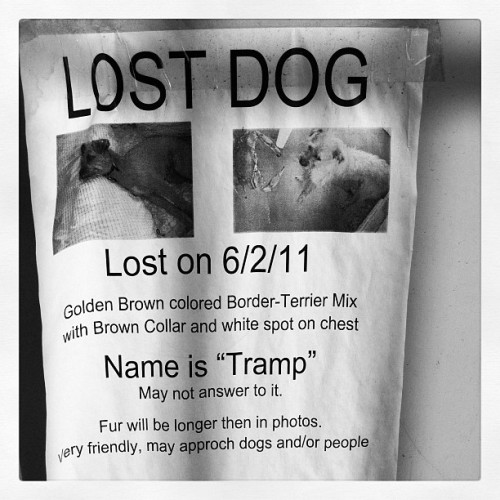
Name is &#8220;Tramp&#8221; (Taken with instagram)
I know how this dog owner feels. I named my cat "Dirty Slut" and she almost never responds when I call her name.

1/19/12

Brian Eno and Leonard Cohen on soul and laments

Couple of quotes from two great musicians...

1. Brian Eno was interviewed on Sound Opinions. He said this about what he looks for in music:

If it's just clever or loud or has all the right software or something, I'm not that interested. I'm looking always for soul. If I'm not moved at that level, if I'm not feeling at some point that it's possible that this could move me to tears or to dancing or to something where I've slightly surrendered to it – if that doesn't happen, it just stays on the shelf. It's an experiment until then.


As applies to comedy: I think that's what the talk about stakes, emotional risks, authenticity, etc. comes down to. The search for soul. That someone is giving themselves to you a little bit.

2. Leonard Cohen said this while accepting an award recently:

As I grew older, I understood that instructions came with this voice. And the instructions were these...Never to lament casually. And if one is to express the great inevitable defeat that awaits us all, it must be done within the strict confines of dignity and beauty.


Never lament casually. If you're going to complain, make it beautiful. Part of why I like comedy so much: I think it's the most beautiful way to complain.

1/18/12

Storytelling tips from The Moth

Went to a Moth storytelling slam in NYC the other week. Packed! Hundreds of people. So supportive of each other. Felt like a bizarro version of the standup world where everyone is polite and pays attention and is encouraging to each other. I kinda hated it. But it was interesting.

FYI, The Moth site offers up these storytelling tips:

Have some stakes.
Stakes are essential in live storytelling. What do you stand to gain or lose? Why is what happens in the story important to you? If you can’t answer this, then think of a different story. A story without stakes is an essay and is best experienced on the page, not the stage.

Start in the action.
Have a great first line that sets up the stakes or grabs attention.

No: “So I was thinking about climbing this mountain. But then I watched a little TV and made a snack and took a nap and my mom called and vented about her psoriasis then I did a little laundry (a whites load) (I lost another sock, darn it!) and then I thought about it again and decided I’d climb the mountain the next morning.”

Yes: “The mountain loomed before me. I had my hunting knife, some trail mix and snow boots. I had to make it to the little cabin and start a fire before sundown or freeze to death for sure.”


Here's a sample Moth story from a comic: Colin Quinn - Toast. ("When asked to perform at Robert DeNiro's birthday party, Colin finds himself in over his head.")

Related: Stakes [Sandpaper Suit]

1/17/12

MTV, Tiger Lily, and Good Magazine mentions

MTV listed 5 Web Comedies To Watch In 2012 and "Made With Love" (with Brooke Van Poppelen and me) makes the list.

I'm out in LA and last night I performed on the terrific show What's Up Tiger Lily? The Tiger Lily team also mentioned me in a post called TigerLily’s Guide to Pilot Season Pt. 1 aka Don’t Miss These Hilarious People…

And Hustlin': Inside the Podcast Renaissance is an article by Gaby Dunn about comedy podcasts that includes some quotes from me. Also included in the piece: Marc Maron, Pete Holmes, and Molly Knefel.

1/13/12

Los Angeles shows: Bang Bang, Tiger Lily, Josh & Josh, etc.

I'm in LA this week. Y'know, the life of a west side playa where cowards die and it's all ball, etc. Got a great week of shows lined up. Come on out and say hey.

Sat 1/14 - 8:00pm - Hand Shucked @ Moving Arts Theater (1822 Hyperion Ave)
Sat 1/14 - 10:00pm - Magic Bag @ Underground Theater (1308 N Wilton)
Sun 1/15 - 8:00pm - French Toast @ Taix (1911 W Sunset Blvd)
Mon 1/16 - 8:00pm - What's Up Tiger Lily? @ Hollywood Studio Bar & Grill (6122 Sunset Blvd)
Mon 1/16 - 10:30pm - Keep It Clean @ Public House (1739 N. Vermont Ave.)
Tue 1/17 - 8:30pm - Comedy Bang Bang @ UCB-LA (5919 Franklin Ave.)
Wed 1/18 - 9:00pm - The Frolic Show @ Far Bar (347 E. 1st Street)
Thu 1/19 - 8:00pm - Josh and Josh Show @ Bar Lubitsch (7702 Santa Monica Blvd)

Tapping into shame and indefensible ideas

Frank Chimero argues shame is the undercurrent of Louis CK's comedy [via MA]:

Louis CK has jokes because he is ashamed of his body, ashamed of his thoughts, his culture, his whiteness, whatever. Every joke seems to be about shame in some way. Ashamed of the things he doesn’t do that he knows he should. Ashamed of the things that he does do that he knows he shouldn’t. Ashamed of his privilege, and ashamed of how he doesn’t do anything to help others who don’t have it. All of these things are about the way Louis lives his life (or the stories he tells about how he does), but they’re also about the lines we draw, the tension of those meeting points of acceptable, common, and desirable behavior, and when our thoughts or actions only meet a couple of those qualifications. For instance, in his newest special, Louis talks about how mind-numbingly boring it is to play board games with his daughter and how much he wants to yell at her for it. Common impulse? Yes. Desirable? Probably, on a very base level to diffuse frustration. Acceptable? Nope. So, we’re ashamed by the those dark thoughts, and Louis is there to give the shameful inclinations credence through his routine. We laugh because we know, and we hear others laugh, so we can hear how we are not alone. The thought gets aired, so there’s less shame to feel...Someone once asked Allen Ginsberg how one becomes a prophet, and he simply replied, “Tell your secrets”...

Articulating our impulses is dirty business, and maybe this is why Louis’ been able to tread in a territory others haven’t been able to navigate. As Fran Lebowitz said, “If you’re going to tell the truth, you better be funny. Otherwise, they will kill you.”


Louis C.K.: The Man Who Loves to Hate Himself is a recent profile of CK in Rolling Stone.

C.K. describes his approach as “deconstruction to a point where you’re left with a fucking mess of unanswered questions. It can be a bit painful and scary. That’s fun for me.” He doesn’t want to come off like some moralizing gasbag, of course, so he’ll throw in something “totally indefensible.” “I’m fucking around with a lot of big ideas, and I don’t have the authority to seriously talk about them. So when I make a joke about a baby with a tree branch growing out of its head being the same thing as a Chinese baby, I don’t expect you to believe any of this. I’m just being a dick.”


Reminds me of his dog phone bit.

1/12/12

Where the ladies at (on Comedy Central)?

New York Magazine wonders why Comedy Central isn't building shows around gals...

Basic cable channels tend to know their audience and then relentlessly target their programming at that niche (just look at the new Lifetime lineup, for example). Still, we can't help but peruseComedy Central's newly announced 2012 development slate, which features twenty potential series projects and seven stand-up specials, and wonder where all the comediennes are. Only one of those shows (and none of those stand-up specials) stars a woman, the Untitled Amy Schumer Project, and in a cinematic year filled with female-fronted comedies like Bridesmaids, Bad Teacher, andYoung Adult, that seems like an out-of-step move for Comedy Central to take. We can't be mad at any network developing shows for Wyatt Cenac, Matt Braunger, and Nick Kroll, but surely there are some comic actresses out there besides Whitney Cummings whom TV shows can be built around?


In the comments, Erin Judge writes, "It's simple. The channels that focus on comedy also focus on advertising to guys. Dudes, specifically." And she points to this article to back up her point.

The bull’s-eye for Comedy Central is the audience of males ages 18 to 34. Any younger, and the beer and car advertisers would be off target. Any older, and there are a dozen other channels advertisers could choose.


So basically: Follow the money.

1/10/12

Pete Holmes is keeping it crispy with You Made It Weird

I have a new favorite comedy podcast: Pete Holmes' You Made It Weird (iTunes). We all know Pete's a great comedian but I didn't know he'd be such a great interviewer too. He's a self-described comedy nerd and he dives deep with the guests and their approach to doing standup, coming up with a persona, writing, evolving onstage, etc. You can tell he's got a genuine curiosity about standup and loves the whole process of creating laughter.

Also, he seems genuinely close with each interviewee so the conversations feel like old friends catching up. Plus, he always makes a point of discussing two topics with each guest that I find intriguing: 1) how to have a healthy relationship while doing comedy and 2) god/religion. Seriously, each episode I've listened to has been fascinating.

If you're looking for a starting point, I'd suggest the Jim Gaffigan, Neal Brennan, and Kumail episodes. Looking forward to more.

1/6/12

Hot Soup is back on Sunday

The lineup for Sunday, Jan 8....

Mike Lawrence
Nick Turner
Mike Recine
Matt Ruby
David Cope

HOT SOUP! at UCB-East
155 E. 3rd Street (at Avenue A)
Every Sunday. Doors at 8:45pm, showtime at 9pm. $5 tickets.
Make reservations now
Produced by David Cope, Mark Normand, and Matt Ruby.

1/4/12

Bill Hicks: The comic is the antithesis of the mob mentality

The Goat Boy Rises is a great Bill Hicks profile from The New Yorker.

Hicks thinks against society and insists on the importance of this intellectual freedom as a way to inspire others to think for themselves. “To me, the comic is the guy who says ‘Wait a minute’ as the consensus forms,” Hicks told me as we climbed the stairs to his dressing room. “He’s the antithesis of the mob mentality. The comic is a flame—like Shiva the Destroyer, toppling idols no matter what they are. He keeps cutting everything back to the moment.”


More on Shiva:

All that has a beginning by necessity must have an end. In destruction, truly nothing is destroyed but the illusion of individuality. Thus the power of destruction associated with Lord Shiva has great purifying power, both on a more personal level when problems make us see reality more clearly, as on a more universal level. Destruction opens the path for a new creation of the universe, a new opportunity for the beauty and drama of universal illusion to unfold. As Satyam, Shivam, Sundaram or Truth, Goodness and Beauty, Shiva represents the most essential goodness.


Destruction that purifies. That sounds like a good way to get the new year rolling.

12/25/11

Holidaze

Jews love watching a movie and eating Chinese food on Xmas Eve. But I'm a self-loathing Jew, so I watched Passion of the Christ and ate Pork Fried Rice.

Ah, good times. Merry Xmas. Happy Hannukah. Blah blah blah. There are no Hot Soup shows tonight or on New Year's Day. We return on Jan 8. And I'll be in LA from Jan 14 - 20 doing shows so stay tuned for updates on that.

Also, this blog will be dormant until the New Year. You can handle it.

12/21/11

The press conferences of The Beatles, Bob Dylan, and Andy Warhol

Press conferences in the sixties sure were strange. The vibe was less reporter/artist and more zoologist/caged-animal. No wonder that clever subjects decided to handle it by being funny, absurd, and/or combative. For example...

The Beatles:


Bob Dylan:


Andy Warhol:

12/20/11

Steve Martin: "I never let them know I was bombing"

A computer scientist talks about lessons learned from Steve Martin's "Born Standing Up."

Paying your dues is overrated. Simply putting in the time is not enough. Martin’s story is one of a constant urge to innovate. He was trying to figure out the essence of “funny.” He then yielded these insights to move beyond the static structure of the punchline that dominated performance comedy at the time. This restless urge to understand then innovate led him to be outstanding. Without it, he would have just become another good comedian. Like hundreds of others.


Being Funny is an article where Martin summarizes his comedy philosophy.

What if there were no punch lines? What if there were no indicators? What if I created tension and never released it? What if I headed for a climax, but all I delivered was an anticlimax? What would the audience do with all that tension? Theoretically, it would have to come out sometime. But if I kept denying them the formality of a punch line, the audience would eventually pick their own place to laugh, essentially out of desperation. This type of laugh seemed stronger to me, as they would be laughing at something they chose, rather than being told exactly when to laugh...

Now that I had assigned myself to an act without jokes, I gave myself a rule. Never let them know I was bombing: this is funny, you just haven't gotten it yet. If I wasn't offering punch lines, I'd never be standing there with egg on my face. It was essential that I never show doubt about what I was doing. I would move through my act without pausing for the laugh, as though everything were an aside. Eventually, I thought, the laughs would be playing catch-up to what I was doing. Everything would be either delivered in passing, or the opposite, an elaborate presentation that climaxed in pointlessness. Another rule was to make the audience believe that I thought I was fantastic, that my confidence could not be shattered. They had to believe that I didn't care if they laughed at all and that this act was going on with or without them.


Related: Excerpts from "Born Standing Up: A Comic's Life."

12/19/11

Where's your family from?

With all this Xmas talk and the long beard I've grown, I'm feeling extra Jewy these days. Even got jealous of a friend's conversation I overheard. He's Italian and this is how it went down:

Friend: Are you Italian?
Stranger: Yeah.
Friend: Where's your family from?
Stranger: Sicily?
Friend: [raises fist] Paisan!

And then they high fived. Which all bummed me out. Because as a Jew, you never get to have an exchange like that. With us, it's more like this:

Jew 1: Are you Jewish?
Jew 2: Yeah.
Jew 1: Where's your family from?
Jew 2: Poland.
Jew 1: Oh. Um. Never forget.

Jews! "Never forget" is like our Jingle Bells.

12/16/11

Christopher Hitchens on the fuel for material

Christopher Hitchens passes away. His views on debauchery reminds me of things I've heard Doug Stanhope say too; That basically, living a long life is less important than living an interesting one.

He also professed to have no regrets for a lifetime of heavy smoking and drinking. "Writing is what's important to me, and anything that helps me do that - or enhances and prolongs and deepens and sometimes intensifies argument and conversation - is worth it to me," he told Charlie Rose in a television interview in 2010, adding that it was "impossible for me to imagine having my life without going to those parties, without having those late nights, without that second bottle."


Here's a compilation of Hitch's smackdowns on religion. For a counterpoint: "Gotta Serve Somebody" by Bob Dylan.

12/15/11

Sunday 12/18: Hot Soup with McCarthy, O'Connor, and Angelo

It's the last Hot Soup of the year. And it's Andy's last show before he splits for the west coast. And after the show, Stephen Merchant, co-creator of The Office and Extras, will be performing standup at his own show. So do it.

Hot Soup lineup:

Matt McCarthy (“a Belushi-like mad man” -NY Times)
Sean O'Connor (Conan)
David Angelo (Late Night with Jimmy Fallon)
Andy Haynes (Late Night with Jimmy Fallon)
Special holiday guests

I'm hosting.

HOT SOUP! at UCB-East
155 E. 3rd Street (at Avenue A)
Every Sunday. Doors at 8:45pm, showtime at 9pm. $5 tickets.
Produced by David Cope, Andy Haynes, Mark Normand, and Matt Ruby.

12/14/11

"Comics who are green try to be more blue to appear less yellow"

"Comics who are green try to be more blue to appear less yellow." Andy Sandford quoted that line to me the other night when we were talking about cursing onstage.

It rang true for me. I used to curse onstage a lot when I started. But eventually it started to bug me when I realized a punchline was hitting because I threw a "fuck" in there. If I took the "fuck" out and it didn't get a laugh, I didn't feel like it was actually a funny joke.

Plus, I've had to do clean shows (church show, opening for headliner who wanted me to stay clean, etc.) and it sucked to sit down and have to eliminate jokes. I don't want to have to think about which material I can or can't do at a show. If everything in my arsenal is clean, it's one less thing to worry about. Not to mention, it was disheartening to vet material before a show and realize a big chunk of my stuff relied on talking about sex or cursing.

Anyway, already discussed this a while back but the green/blue/yellow line was clever enough that I thought I'd bring it up one more time.

Btw, here's Stanhope's defense of cursing (“that’s just how I talk”) which I get; Being who you are offstage when you're onstage makes sense. But I'm not a guy who curses all the time in real-life so it feels like doing it onstage a lot would be solely for shock value.

12/13/11

CK and el Duque

CK answers reader questions at Reddit.

You need to get on stage as much as possible and vary your stage experience as much as possible and not quit and take care of yourself and always question why you say the things you say and enjoy yourself...

i don't know about "Supposed to" I think there's a million ways to do things. there was a pitcher for the Yankees once named Orlando Hernandez or "el Duque" he was a cuban exile. A thing they said about him was he was hard to hit cause he had so many arm angles and release points. a hitter studies a pitcher and watches for the ball so he can time it, but with el duque, you don't even know where the fucker is coming from. Nine o clock? Eleven? And does he let go of it up top or out front? Impossible. I sometimes think of comedy in those terms.


The baseball reference reminded me of his talk about "brushback pitch" jokes a few years back.

And if you don't know already, his new special is avail online for $5.

12/12/11

Sandpaper Suit Podcast Episode 4 - Myq Kaplan and Josh Gondelman

It's back. Three Jews with beards — Myq Kaplan, Josh Gondelman, and me — share a car ride from NYC to Boston and talk about fame, comedy, philosophy, girls, and more. Listen below or get it at iTunes or download the MP3.

12/9/11

A special We're All Friends Here with Mark and me in the hot seat

Saturday 12/10: We're All Friends Here
It's been requested for years. Now it's happening! Mark and I sit on the hot seat and answer questions from each other and guest co-host Neal Stastny. It's gonna be intense. Dan Soder does a set to open up.

Saturday, Dec 10 - 8:00pm
FREE
The Creek and The Cave
10-93 Jackson Avenue
Long Island City, NY

...

Sunday 12/11: Hot Soup
Harrison Greenbaum
Phoebe Robinson
Jessi Klein
Bryson Turner
David Cope

HOT SOUP! at UCB-East
155 E. 3rd Street (at Avenue A)
Every Sunday. Doors at 8:45pm, showtime at 9pm. $5 tickets.
Make reservations now
Produced by David Cope, Andy Haynes, Mark Normand, and Matt Ruby.

Also, check out David Cope's new web series Strung Out, a comedy about playing harp in the big city. Here's the first episode, featuring Reggie Watts.

12/7/11

Anthony Jeselnik's Dane Cook impression

Soem guys write jokes and stand there and tell 'em. Some guys rely on physicality and act outs to get laughs. Here's what happens when the former impersonates the latter:

12/6/11

What Comedy Central Records looks for in a comedian

An interview with Comedy Central Records' Founder/Vice President Jack Vaughn [thx OE]. He's asked, "How do you discover talent?"

Ultimately, there are basically two criteria for who we sign to the label:

1. You have to be really funny.
2. You have to have a distinctive voice or point of view.

That’s it. Things like having a strong following or being on TV or in movies is great, but those two criteria are the main things we look for.


And he also discusses the recording process.

One of the quirks of this genre is that the audience tends to be the most important part of the recording, and how the audience reacts can drastically change how the jokes are perceived by the listener. Jokes seem funnier the harder people are laughing at them — this is the reason sitcoms customarily use laugh tracks — which may seem obvious, but you’d be surprised just how important it is.

By the time of the album recording, the comic has gotten so good at doing the material that the differences in delivery among the sets are usually minimal. But the difference between an intelligent, raucous audience in a packed room, and a sober one in a half-empty club is staggering. We’ll re-record shows if the audience isn’t good enough.


I hadn't really realized that CCR almost singlehandedly brought comedy albums, which hadn’t sold much since the late seventies/early eighties, back into vogue.

12/5/11

Being self-effacing and why male comics obsess about their weight

Why Are These Hip Male Comedians All Talking About Their Weight? is an article that claims "talking about this publicly is their way of pushing the envelope. "

[Marc] Maron’s not the only male comedian who’s been talking about his food issues lately—a topic that’s culturally associated with, well, teenage girls. Louis C.K. talks constantly about his weight...Patton Oswalt talks about his struggles with weight on his latest album, Finest Hour—and on this recent appearance on Conan. Oswalt jokes about getting out of breath when he dances with his toddler daughter—and about joining, then leaving, Weight Watchers, because the meetings didn’t have the same frisson as AA gatherings. “They're very helpful, but all my friends who are drug addicts and drunks, their meetings are awesome—they have all these dark stories: ‘I T-boned a school bus.’” Meanwhile, the stories at Weight Watchers are about being embarrassed in a bathing suit and trying to avoid pie...

It’s still at least somewhat taboo for men to be seen as obsessing about their weight, so talking about this publicly is their way of pushing the envelope. When they were younger, rebelling meant challenging the ruling paradigm or the trappings of middle-class life. “Now the enemy is really ourselves, and the struggle between accepting ourselves or hating ourselves,” Maron said.


Funny to me how this piece describes talking about weight as pushing the envelope. Was it pushing the envelope when Louie Anderson did it decades ago?


(Love this line: "When I go camping, the bears put their food up in the trees.")

I'd argue that "pushing the envelope" and "fighting taboos" is only a tiny part of why comics talk about being fat, single, balding, ugly, or other self-effacing stuff. They do it because 1) it gets laughs since it's the opposite of how people usually present themselves and 2) it disarms an audience.

I think it's tough to underestimate that second reason. I feel like being mean to myself onstage gives me more room to be mean to others too. After all, I'm willing to point the finger at myself so why not at the rest of the world too? Without self-effacing material, you start to seem like a pretentious, know-it-all asshole who thinks he's better than everyone else. Show some flaws and you humanize yourself.

Or, as Eddie Brill put it, get out of "you suck" territory and bring it into "we suck." That helps get an audience on your side. Then you can go wherever you want with them.

12/1/11

Gary Gulman on when an audience's laughter isn't important

Gary Gulman is asked, "Are there jokes that you do just for you?"

For me at this point I do all the jokes for me, not in a self-indulgent way, but there's nothing I say just to get a laugh. I do a joke because it's funny or clever or meaningful to me.

That hasn't always been the case. For years it was a mixed bag. I did some jokes just because they worked and gave me that oxygen we need. I was looking to get hired, which is a terrible motivator for an artist, but I've evolved, hopefully.

The greatest thing I ever heard related to this was in the Curb Your Enthusiasm pilot. Someone, it may have been Jerry Seinfeld, said that Larry had unwavering convictions as to what he thought was funny. That's essential to becoming unique/original and it's hard to stay true to in an environment where the audience's laughter is (wrongly I feel) considered so important in measuring a performer's talents.


Part of the series Comedy Writing by Mike Bent which looks pretty decent. Below, an excerpt from Everything You Know is Wrong by Bent.

The members of Firesign Theater said it all when they named their 1974 album “Everything You Know is Wrong.” That's the attitude you have to take. You need to question everything around you. You can't just accept things as they are; you need to consistently challenge the status quo. That doesn't mean you have to be an outcast from society; it just means you need to look at things differently.


The full "Comedy Writing" series.

Moving on/Subscribe to my newsletter

I only post on rare occasions here now. Subscribe to my Rubesletter  (it's at  mattruby.substack.com ) to get jokes, videos, essays, etc...